Home >
Commitment to Reconciliation
Indigenous communities have much to teach the world about how to live well, together and in relationship with the land. Their approaches are both innovative and grounded in traditional ways of knowing and being. Today, Tkaronto is home to home to over 80,000 Indigenous people[1] from across Turtle Island, including First Nations, Métis and Inuit peoples.
But 90%, or 72,000 Indigenous people in Toronto, live below the low-income cut-off (LICO).[2] This is the legacy of colonialism and ongoing systemic anti-Indigenous racism. At the heart of decolonizing philanthropy is supporting Indigenous self-determination and acting with reciprocity, which means building relationships based on mutual respect, trust, generosity and appreciation.[3] Philanthropy has an important role in this work.
Supporting Reconciliation
Nearly 30 Indigenous-led agencies operate in Toronto providing services and programs that enhance the cultural and socio-economic wellbeing of Indigenous people and the broader community. Supporting their work is an act of reconciliation that advances Indigenous self-determination.
At Toronto Foundation, we're committed to continuously learning and examining our work to rectify the power imbalance in philanthropy, engaging our fundholders and other partners on this journey of reconciliation and building towards true reciprocity.
Reconciliation in our work
Since 2017 our work has been inspired by our signing of The Philanthropic Community’s Declaration of Action (The Declaration) - a commitment by philanthropic organizations to embedding reconciliation and reciprocity into philanthropic work.
Here are some ways our work is evolving from our experiences and learnings.
Building Relationships
Our work has been strengthened and enriched by the knowledge, expertise and lived experience that these organizations and their leaders, staff and community members have generously shared with us.
Granting
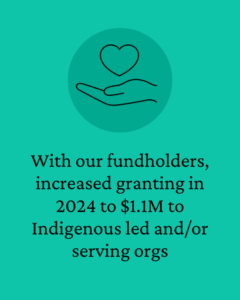
We’ve learned to reimagine our granting processes to better reach, support and empower Indigenous-led and/or serving organizations as they pursue their own priorities and strengthen their role in a connected, vibrant and more equitable Toronto.
Other steps we've taken
Our work has been strengthened and enriched by the knowledge, expertise and lived experience that these organizations and their leaders, staff and community members have generously shared with us.
Takeaways for philanthropists
Whether you are just starting to consider Reconciliation in your philanthropy or you’re searching for deeper context and action, here are some steps you can take.
Get to know these organizations
Get to know these Indigenous organizations working in neighborhoods across Toronto.
Reconciliation events
Each year, we bring fundholders together in person with Indigenous leaders from local Indigenous community organizations to connect and learn.
Conversations on key themes
From topical issues to historical context, below we’ve highlighted some important themes we’ve heard in our conversations with leaders.
Expanding your information sources
By accessing Indigenous-led news, media, art, community organizations and other sources, you can broaden your knowledge and perspective about the experiences of Indigenous peoples including the strengths and successes along with the challenges being faced. Here are some ways to more regularly listen to more Indigenous voices.
Evolving your philanthropy
Here are some steps you can take to advance reconciliation through your philanthropy.
Suggested Resources
From topical issues to historical context, below we’ve highlighted some important themes we’ve heard in our conversations with leaders.
Endnotes:
- Toronto Aboriginal Support Services Council (TASSC).
- TASSC.
- Walrus Talks: How to decolonize Indigenous philanthropy, Roberta Jamieson.