

Compared to 2018, Torontonians aren’t doing as well when it comes to life satisfaction, mental health and their outlook on the future. Younger residents of the city, as well as those with lower incomes, are faring worse than their older and higher-income counterparts respectively. Over time, the gaps between age and income groups have widened.
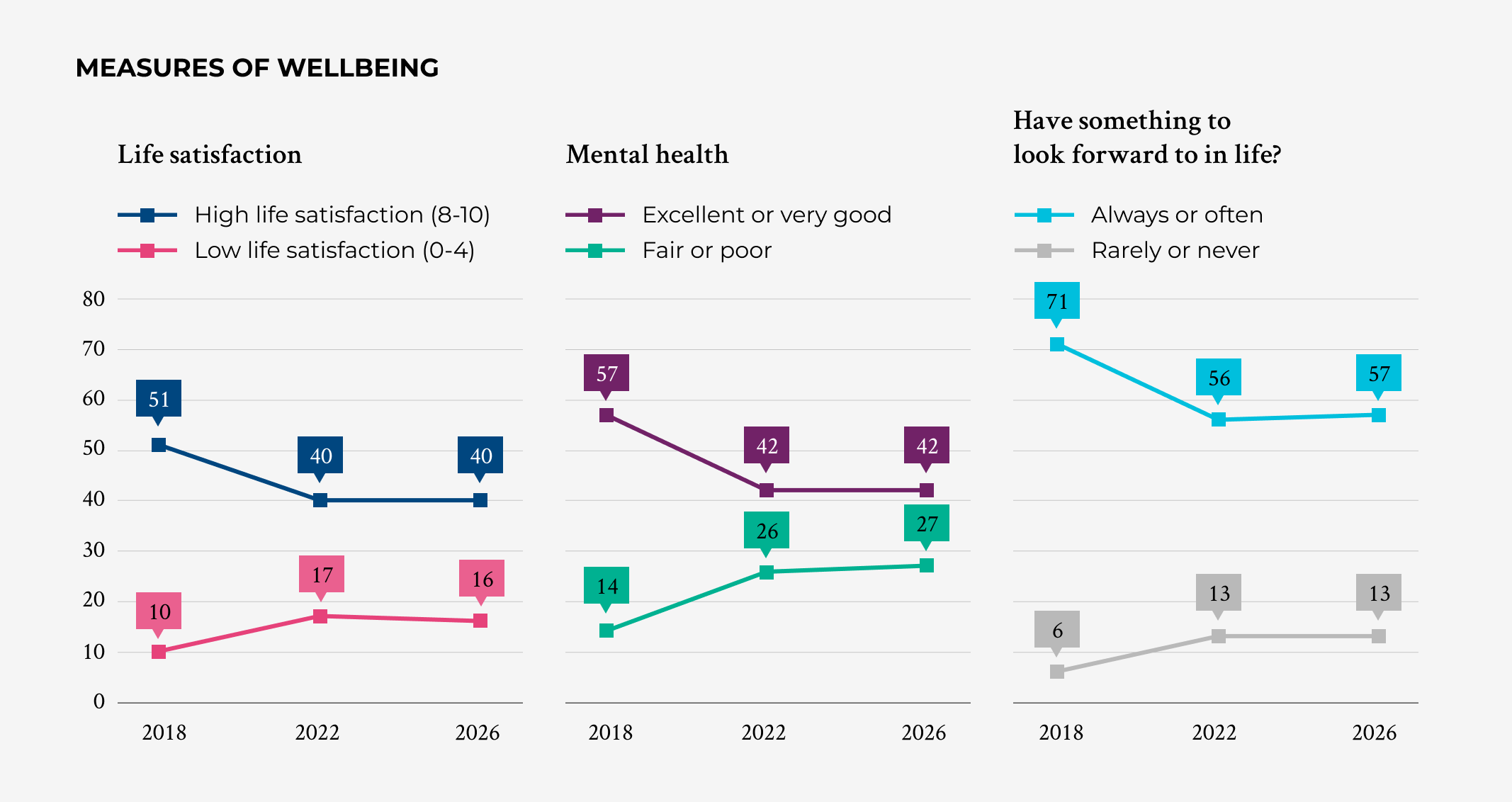
Measures of wellbeing in Toronto declined significantly between 2018 and 2022—and have yet to recover.
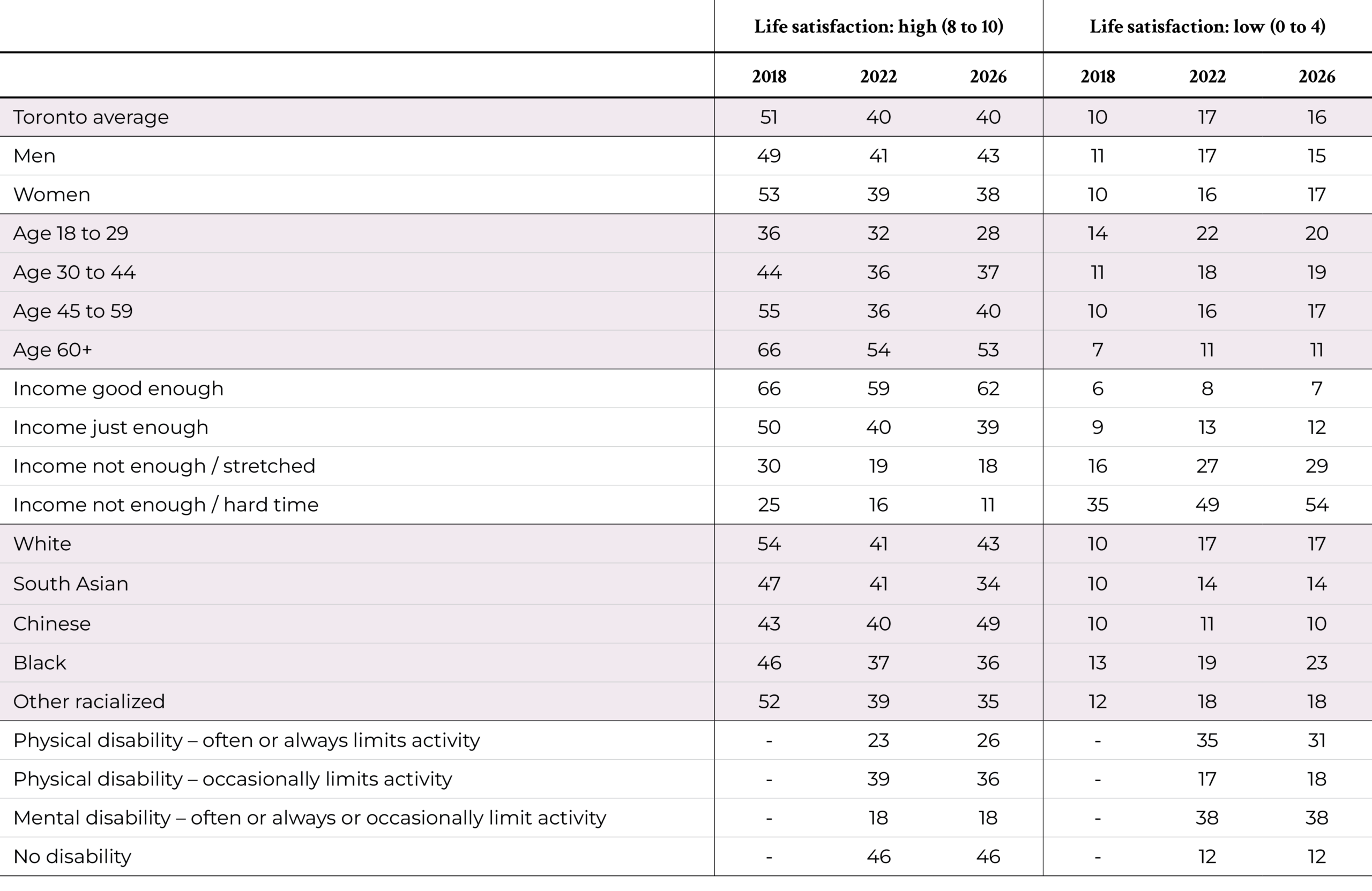
- Three key measures of wellbeing—overall life satisfaction, self-reported mental health, and the feeling that you have something to look forward to in life—all worsened in Toronto between 2018 and 2022. These three measures then held stable between 2022 and 2026.
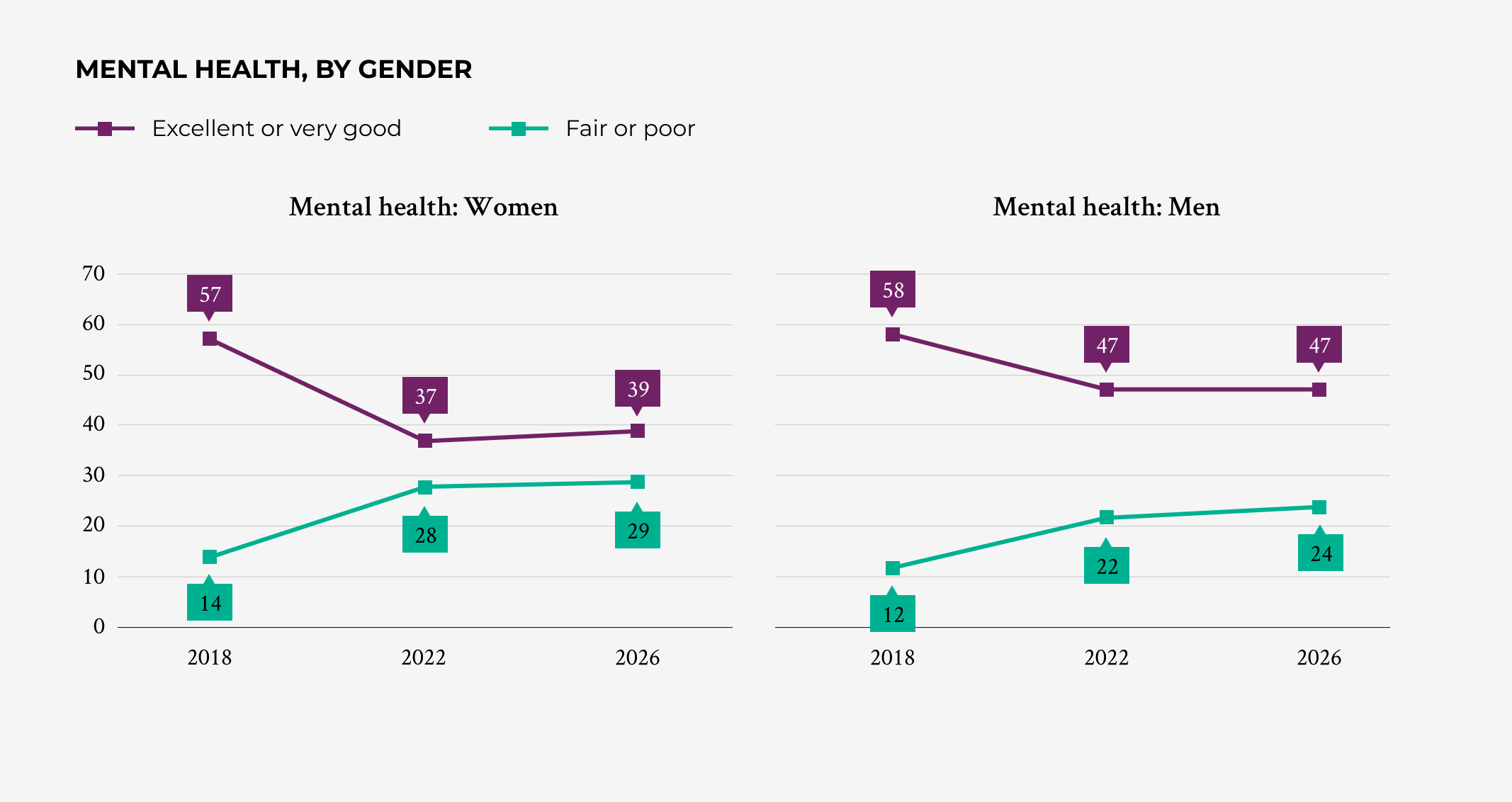
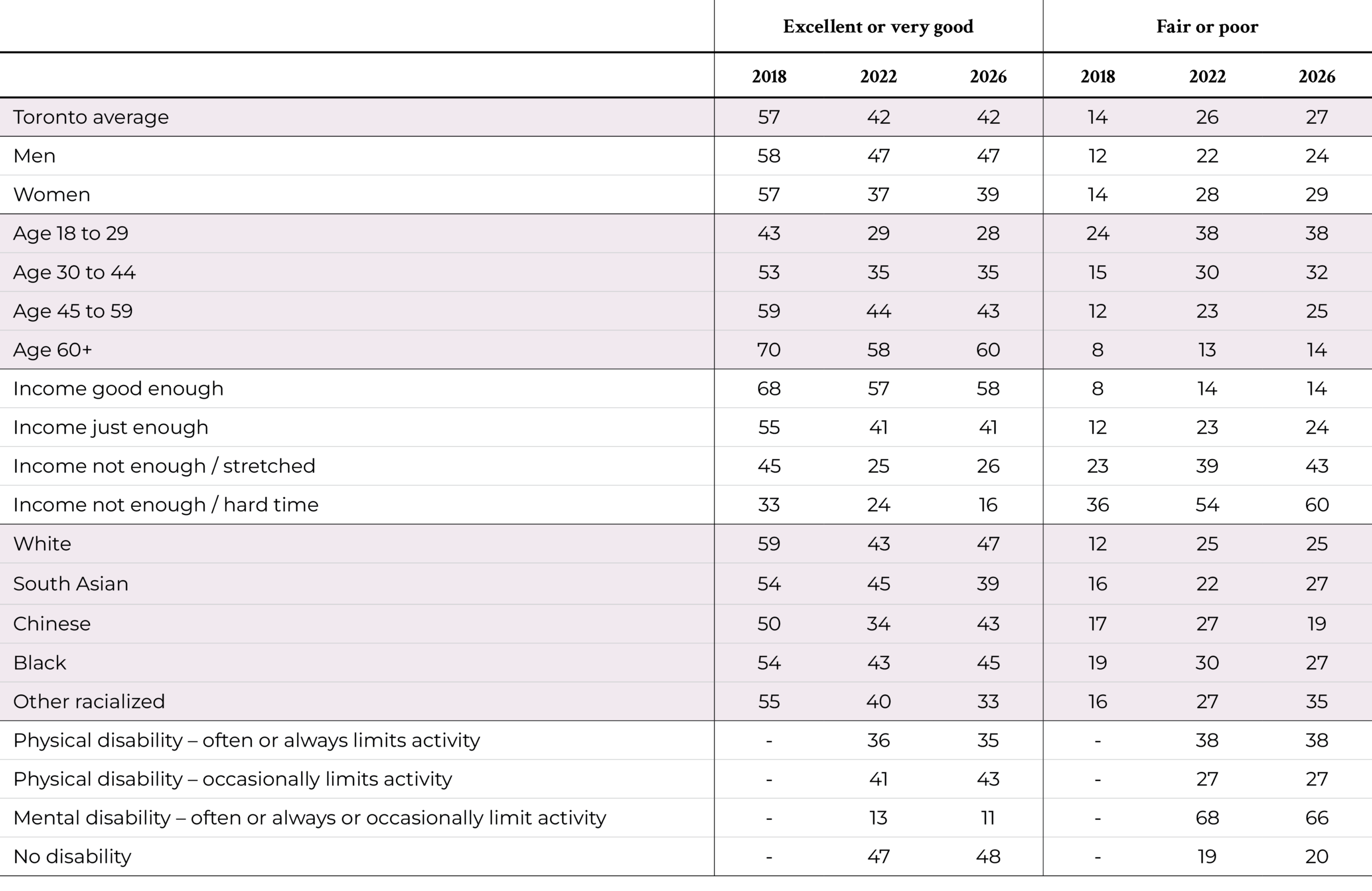
Measures of wellbeing in Toronto have worsened more for women than for men.
- Since 2018, the declines in measures of wellbeing in the City of Toronto has been somewhat more pronounced for women than for men.
- The proportion with high life satisfaction (between 8 and 10 on the scale from 0 to 10) fell by 15 percentage points for women, compared to a six-point drop for men.
- The proportion reporting excellent or very good mental health fell by 18 percentage points for women, compared to an 11-point drop for men.
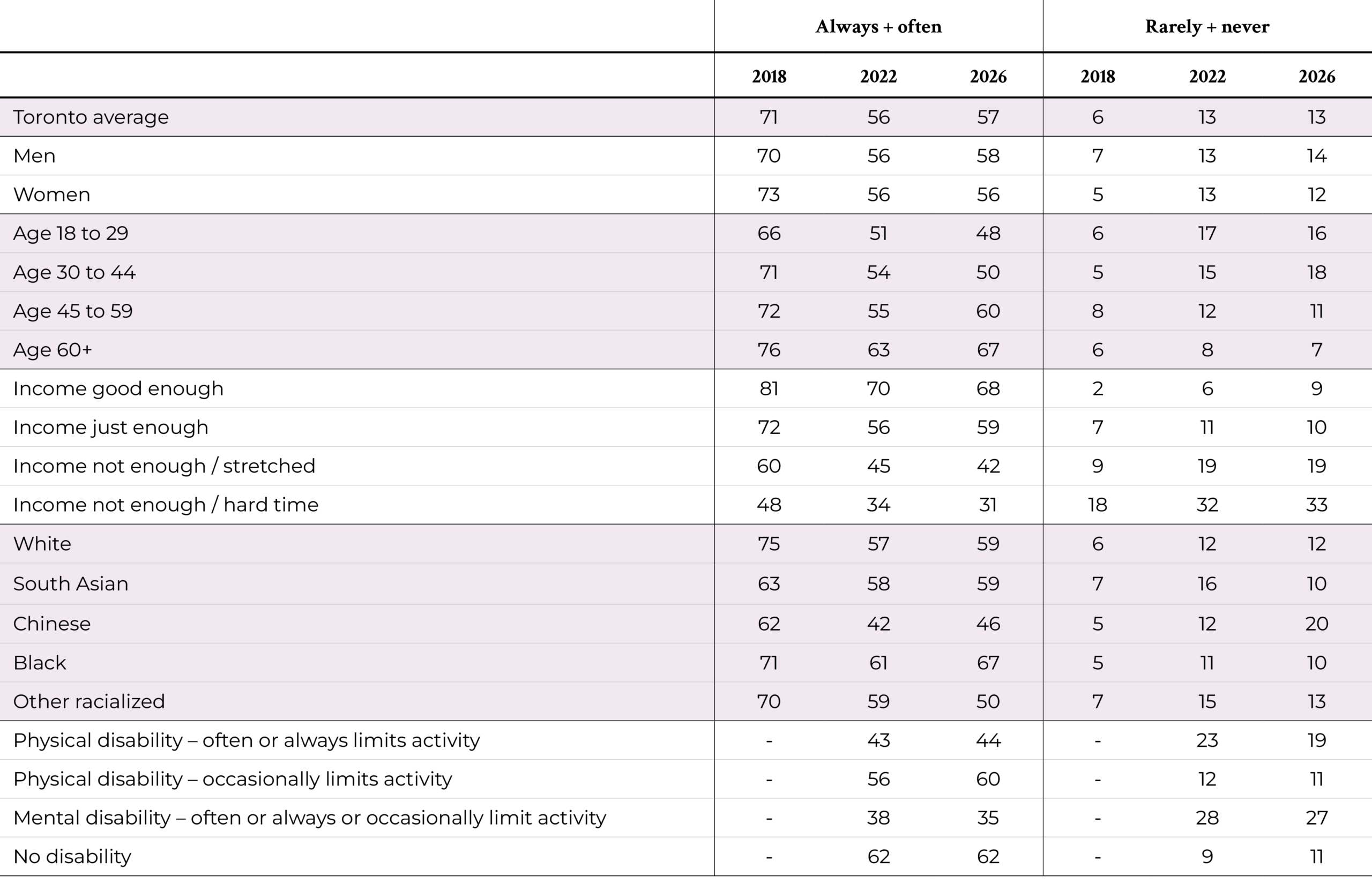
- The proportion that feels they always or often have something to look forward to in life fell by 17 percentage points for women, compared to a 12-point drop for men.
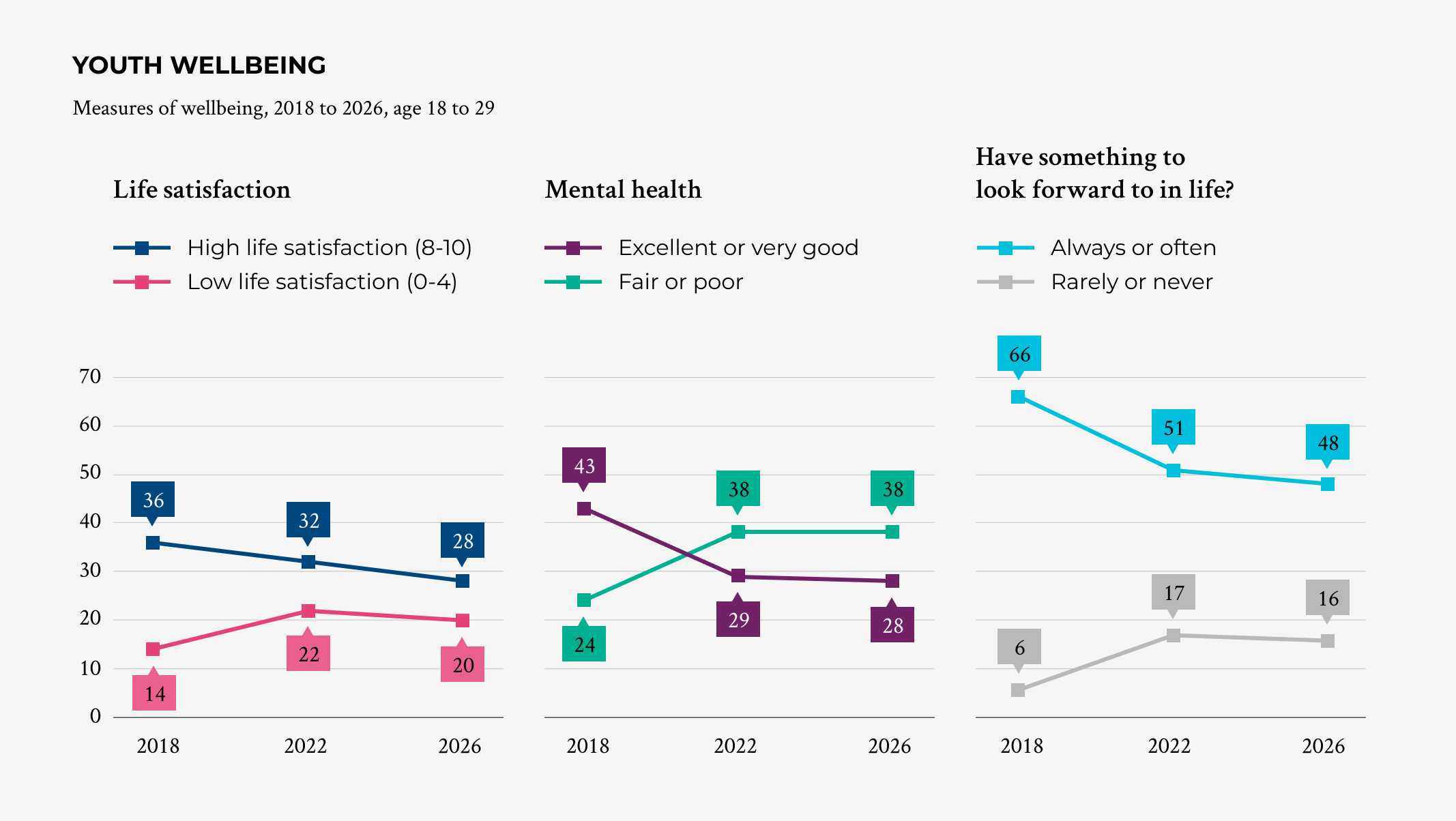
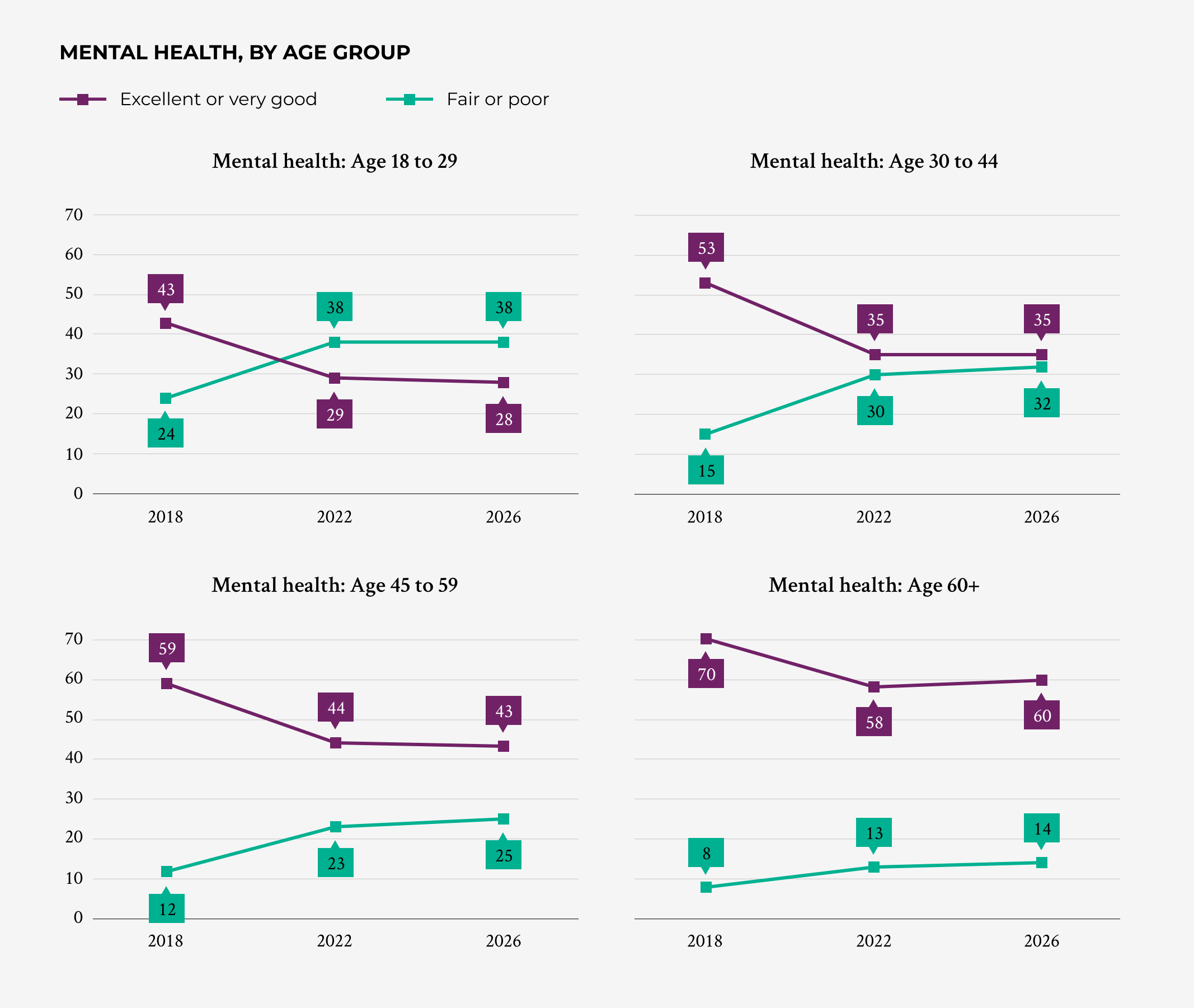
Measures of wellbeing in Toronto have worsened more for younger residents.
- In each of the three Toronto Social Capital Studies, beginning in 2018, younger residents of the city have scored worse than their older counterparts on measures of wellbeing.
- However, measures of wellbeing have also worsened more since 2018 for younger than for older city residents. As a result, the gap between younger and older residents has widened.
- In 2018, younger Torontonians (age 18 to 29) were 19-points more likely to describe their mental health as excellent or very good (43%) than they were to describe it as fair or poor (24%). But the situation has now reversed: they are now 10-points less likely to describe their mental health as excellent or very good (28%) than they are to describe it as fair or poor (38%).
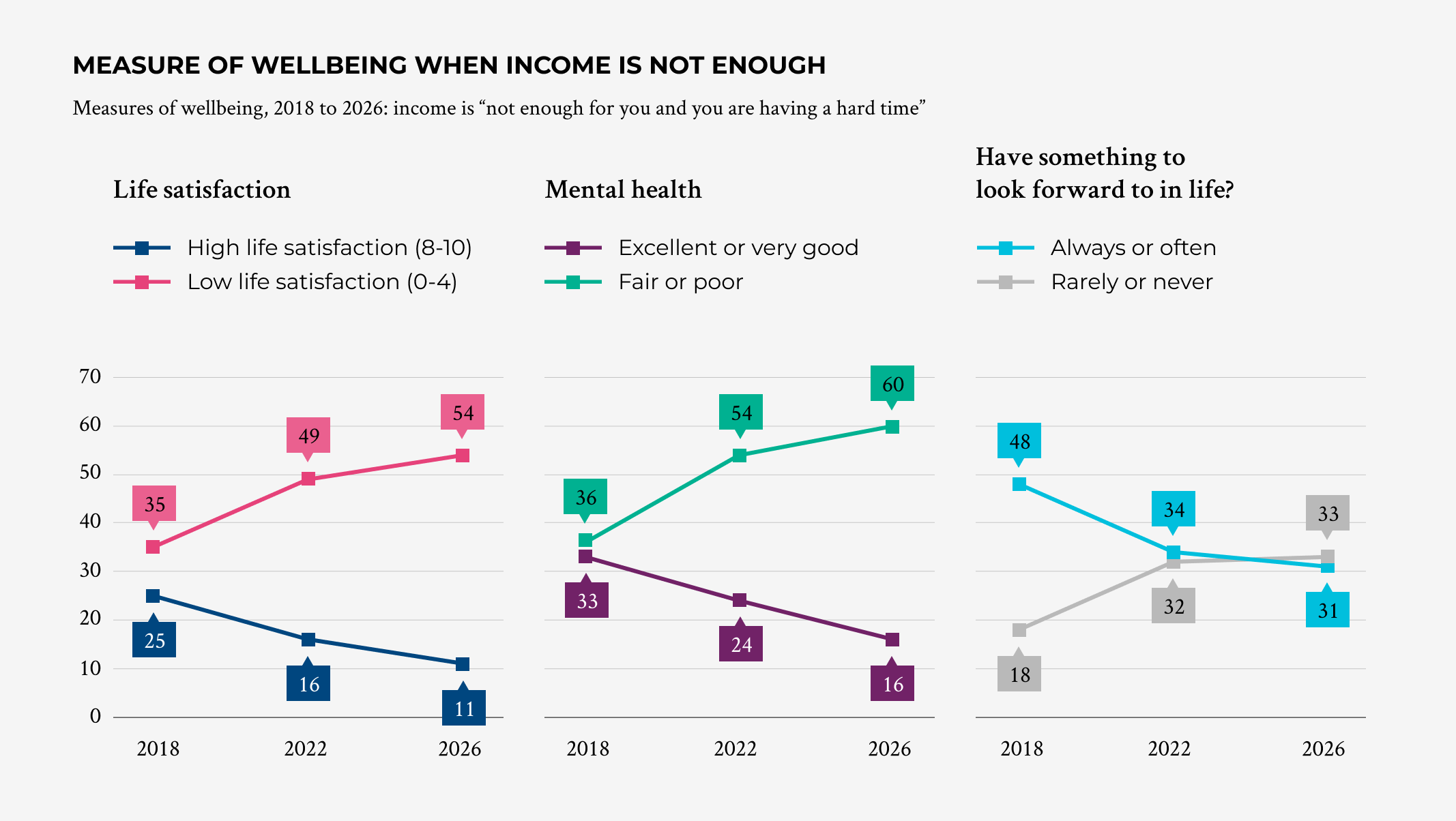
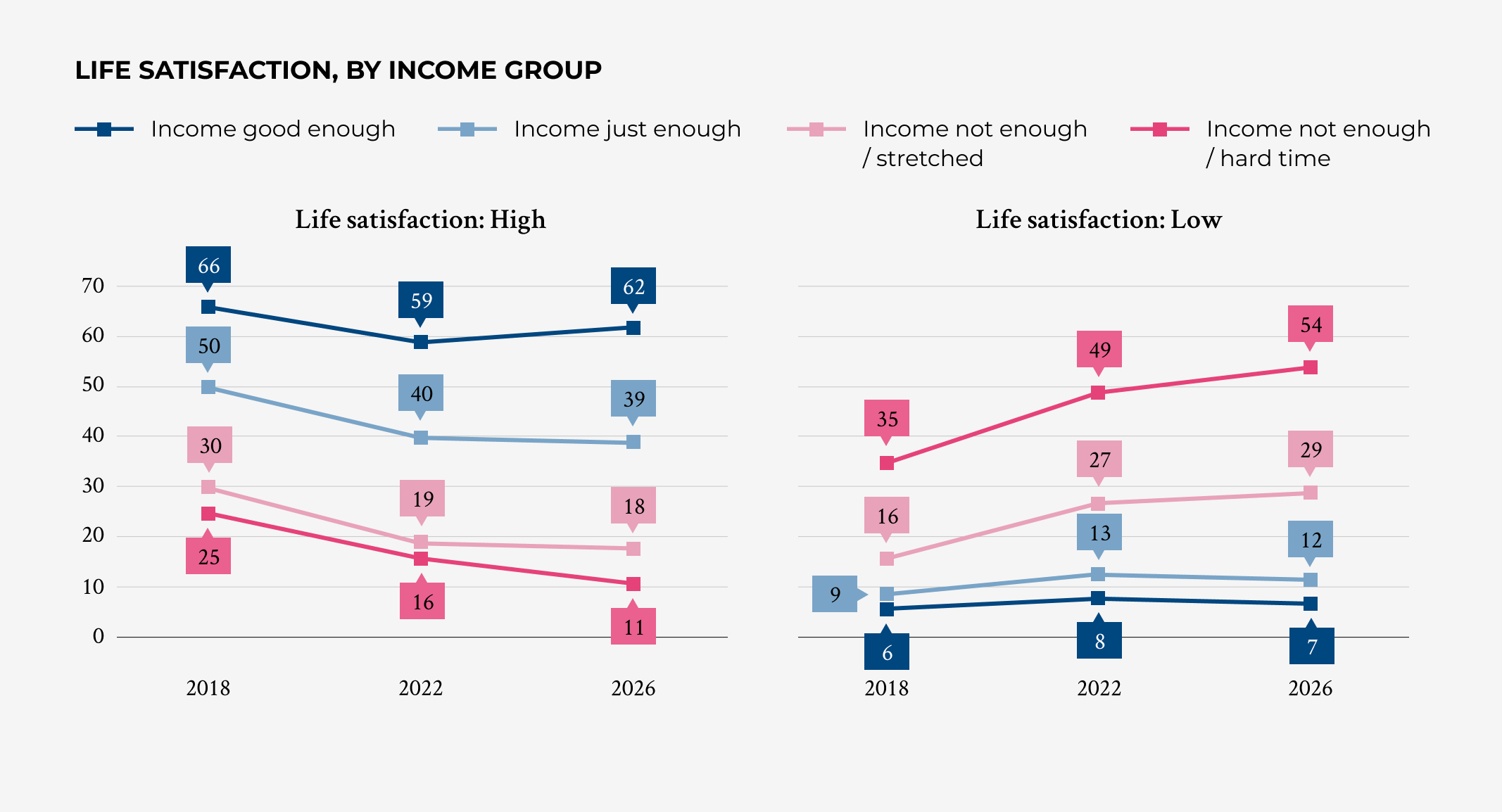
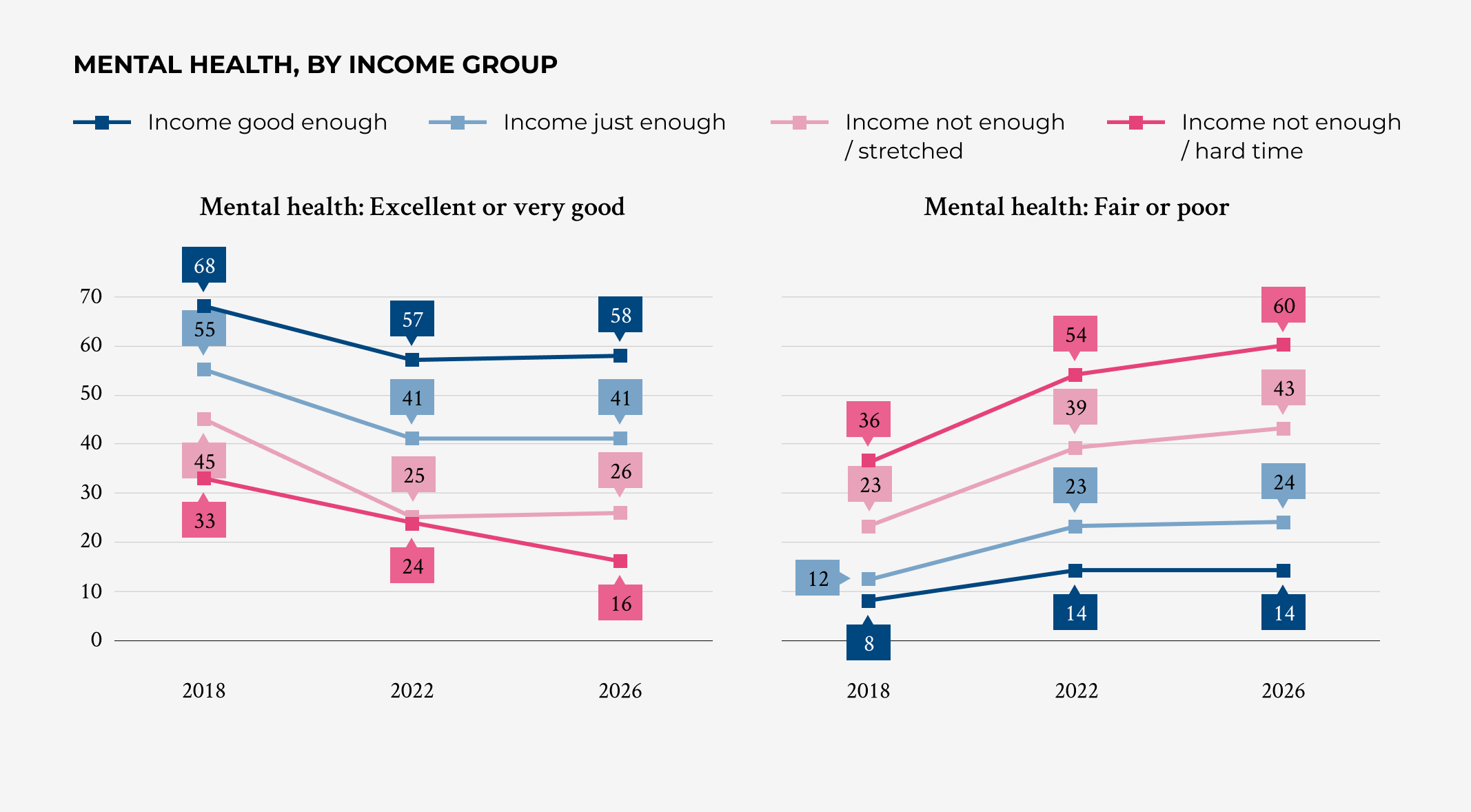
Measures of wellbeing in Toronto have worsened more for residents facing income insecurity.
- In each of the three Toronto Social Capital Studies, beginning in 2018, lower-income residents of the city have scored worse than their higher-income counterparts on measures of wellbeing.
- While measures of wellbeing have worsened for all income groups, the decline is more pronounced for those facing the greatest income insecurity. As a result, the gap between lower- and higher-income residents of the city has widened.
- In 2018, the proportions of lower-income Torontonians reporting their mental health to be excellent or very good, or to be fair or poor, were roughly equal. In 2026, the proportion of these city residents reporting their mental health to be fair or poor is almost four times as great as the proportion reporting it to be excellent or very good.
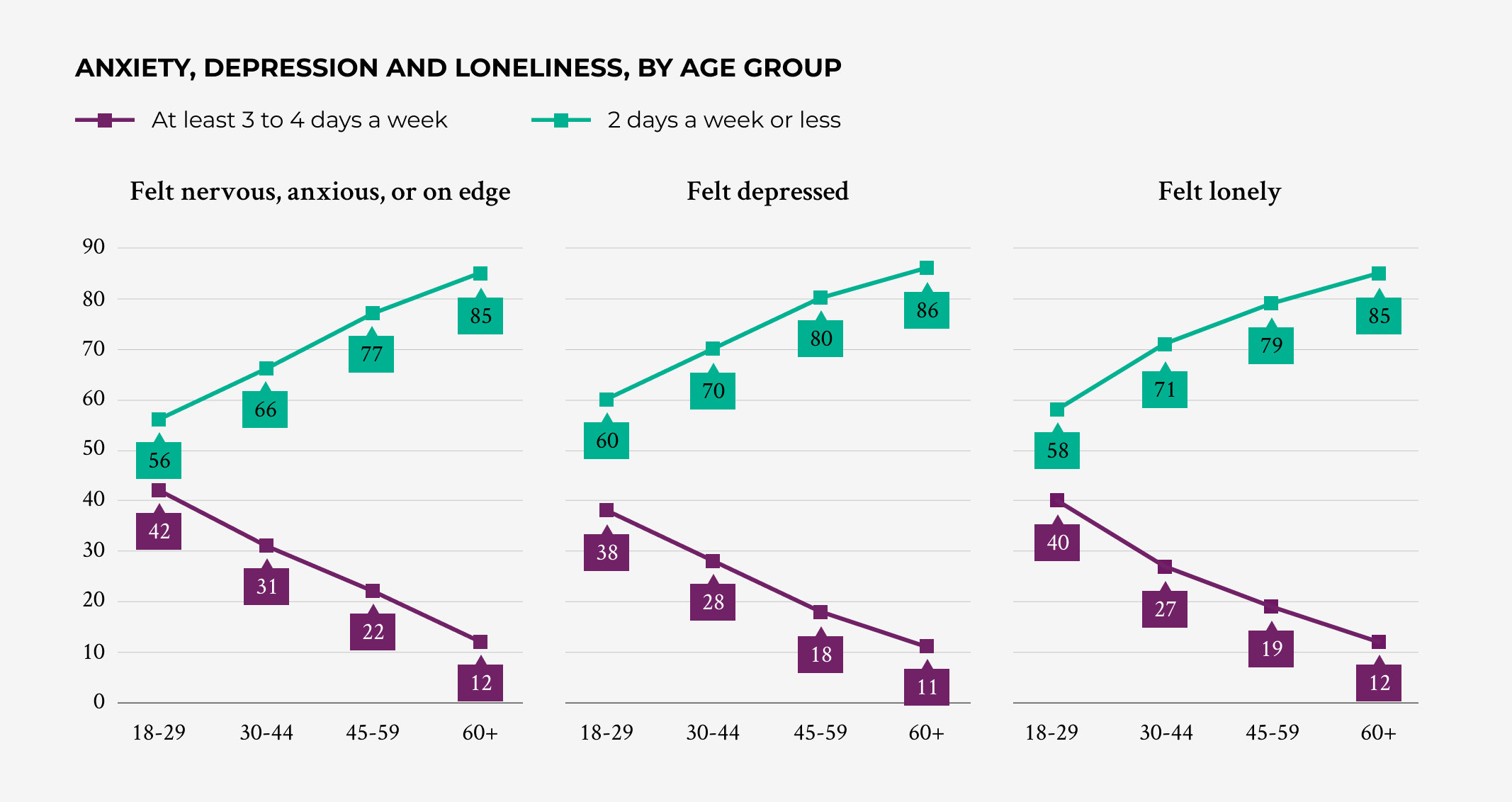
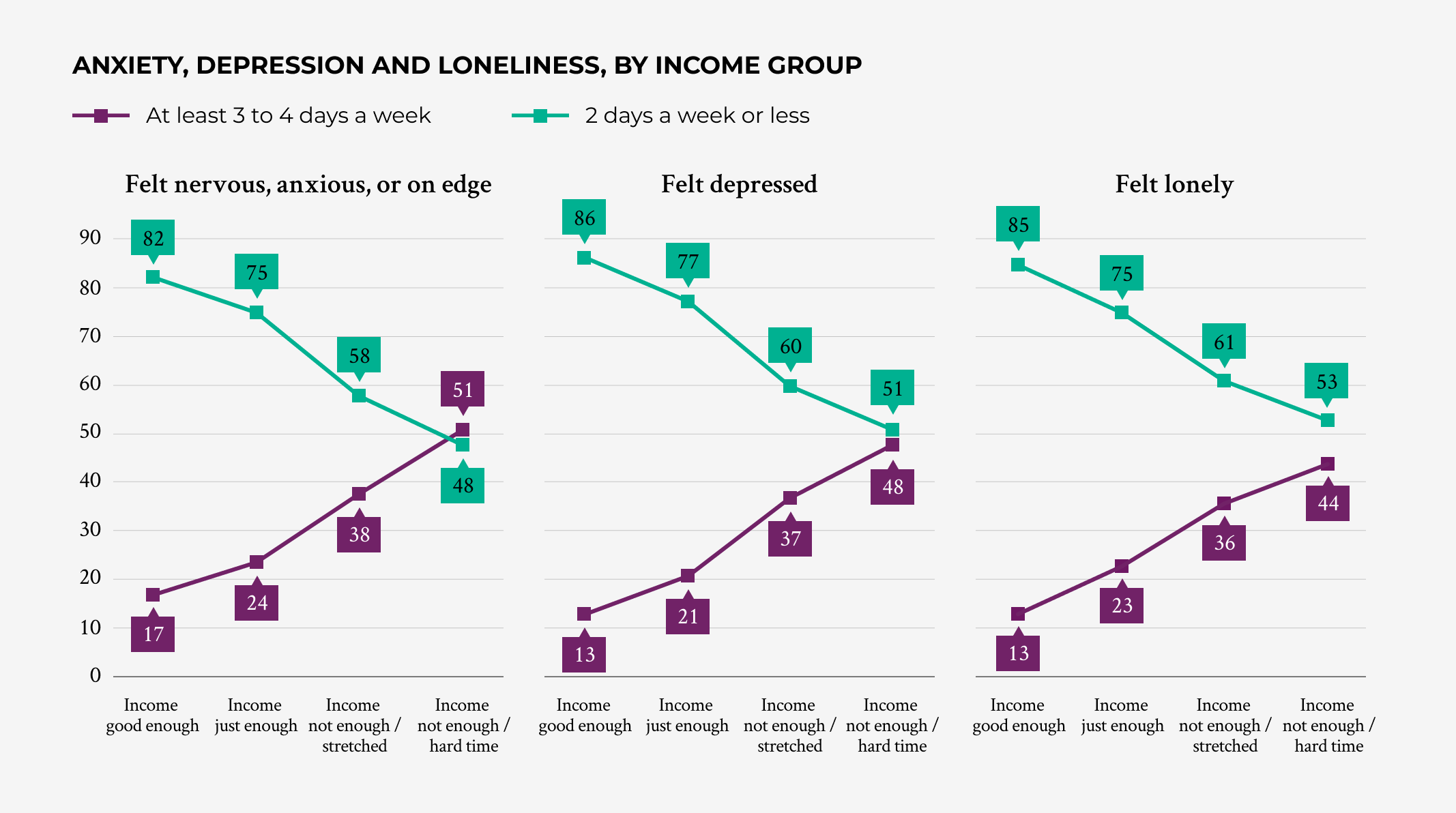
Younger Torontonians, as well as lower-income residents of the city, report more frequent feelings of anxiety, depression and loneliness.
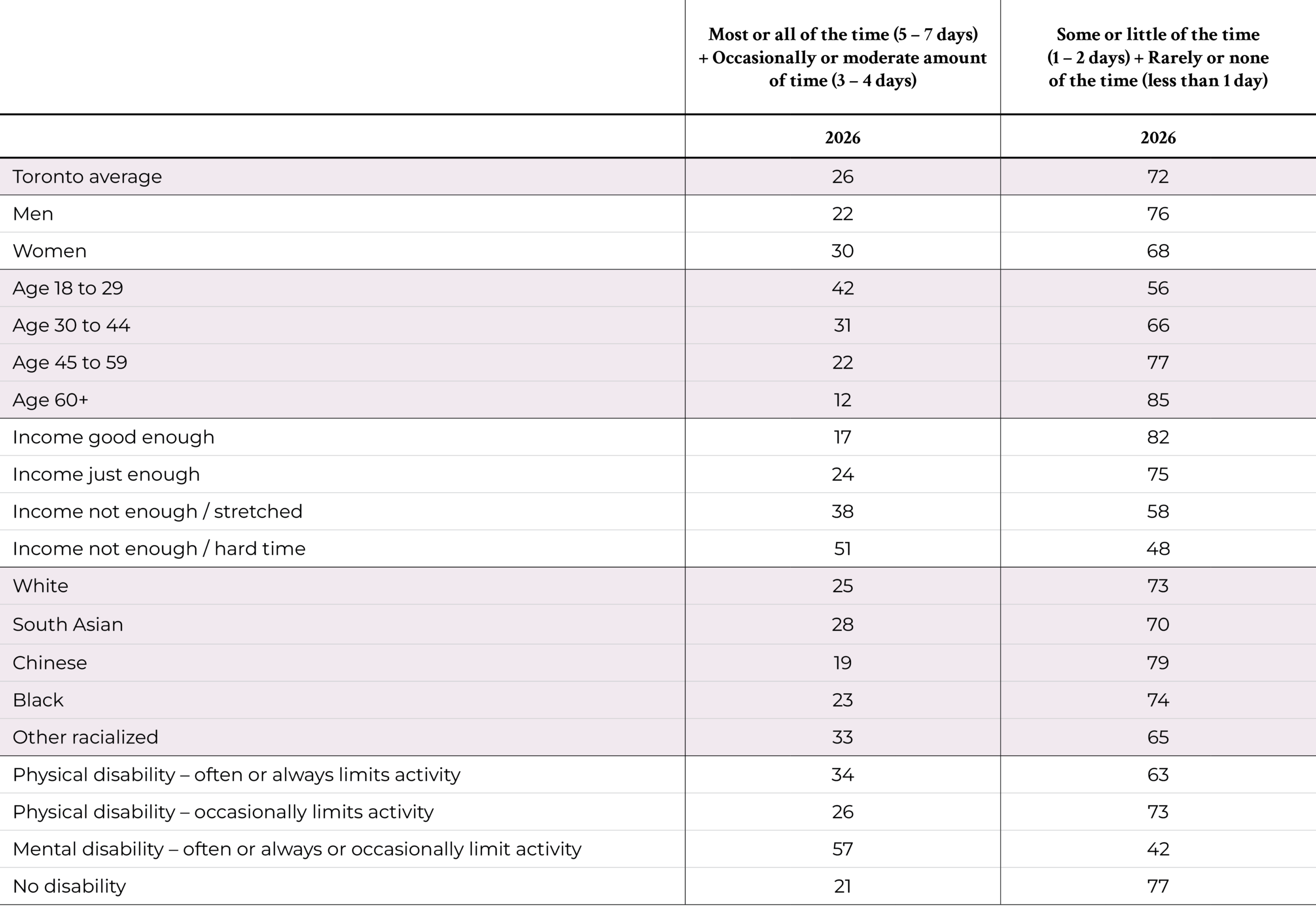
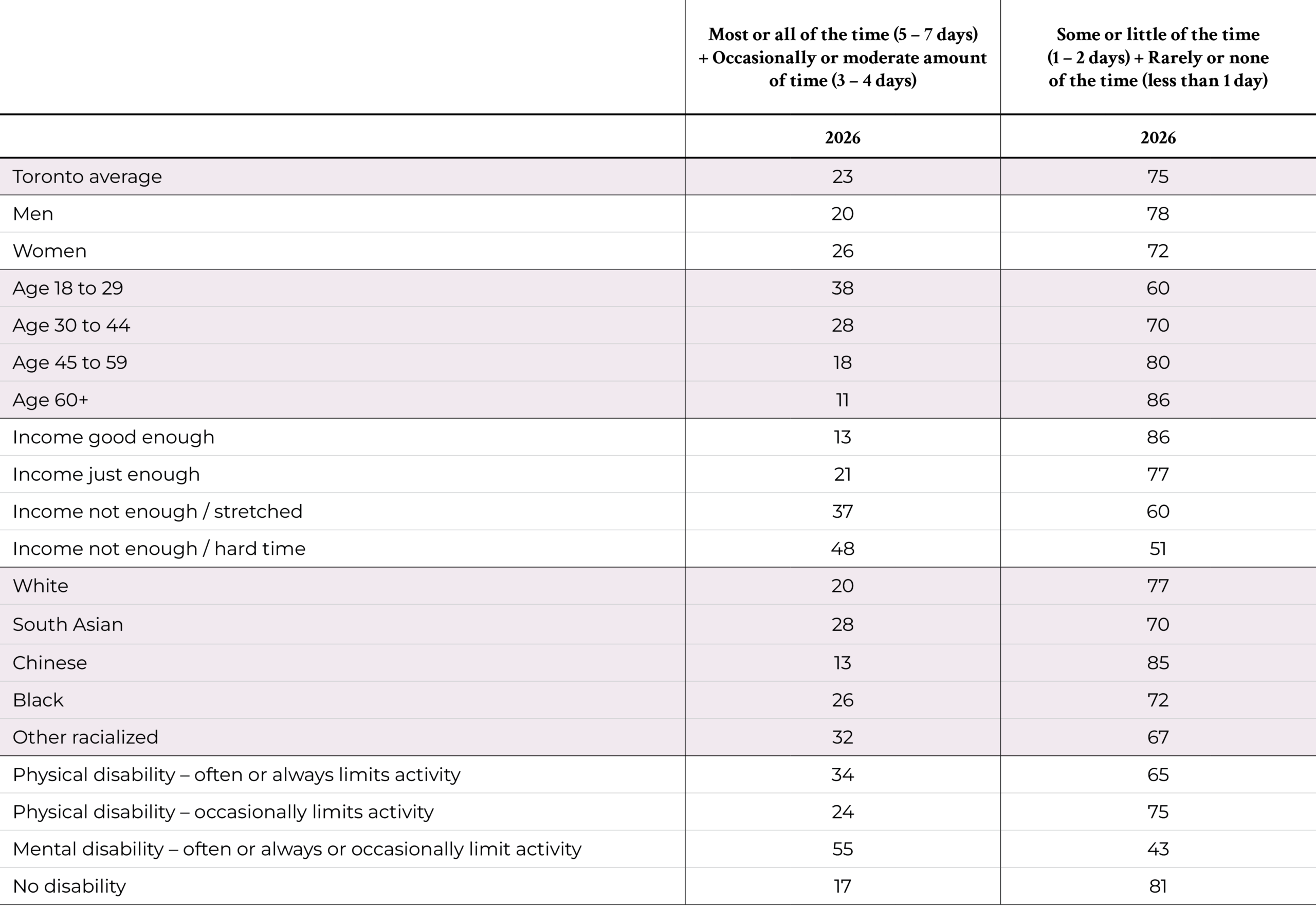
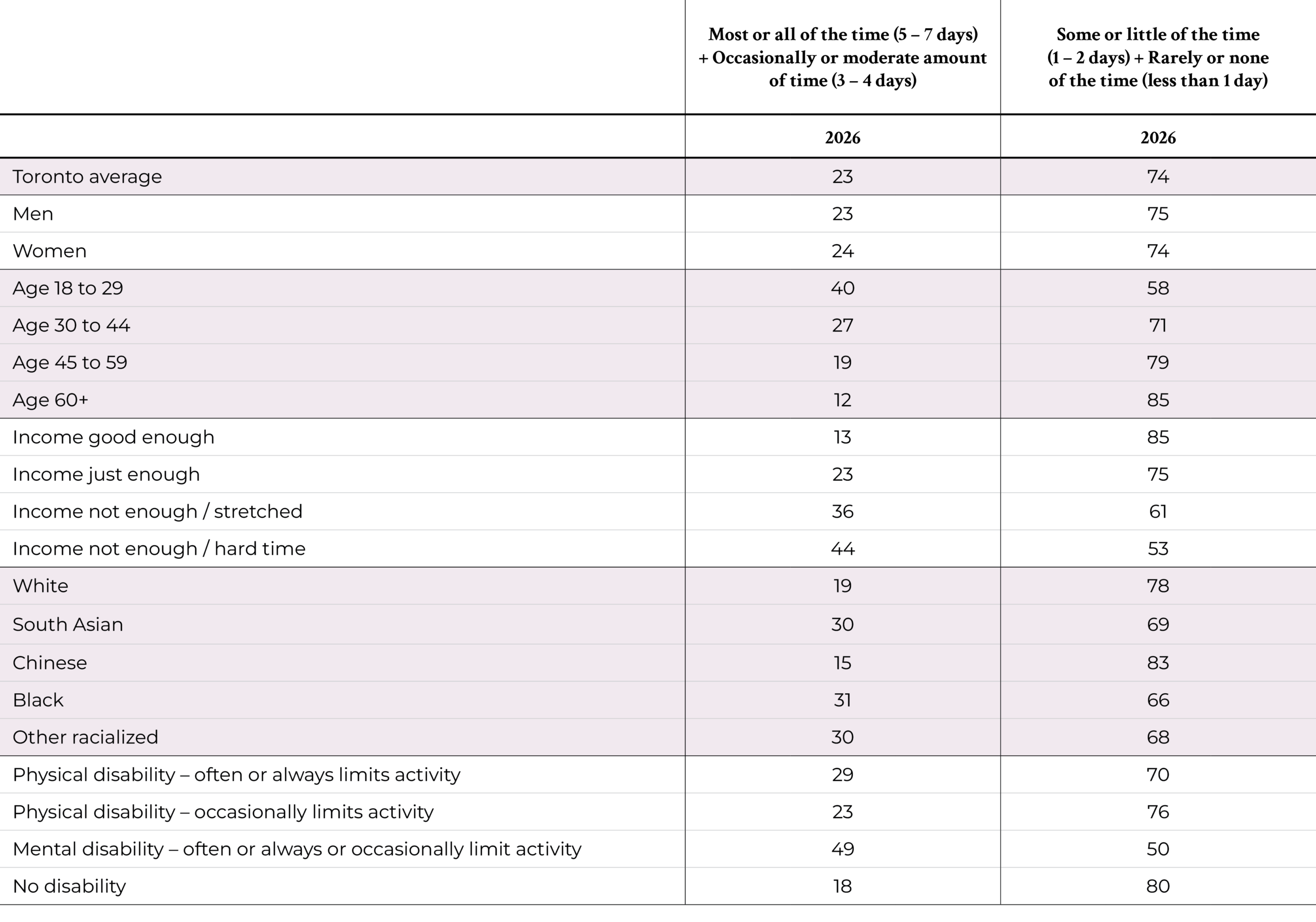
- The 2026 survey included a question about the number of days in the past week Torontonians experienced feelings of anxiety, depression and loneliness.
- About two in five younger Torontonians (age 18 to 29) report experiencing each of these feelings at least three to four days per week, if not more often. This compares to about one in ten of those age 60 and older.
- Experiences of anxiety, depression and loneliness also increase as income security decreases. Compared to their higher-income counterparts, those lower-income Torontonians are three times as likely to experience anxiety, and more than three times as likely to experience depression and loneliness, at least three to four days per week, if not more often.
Torontonians with a physical disability that regularly limits their activity, or with a mental health disability, report worse wellbeing than average.
- The 2022 and 2026 surveys included a question about whether a person has a disability, defined as a physical condition; a cognitive difference; an emotional, psychological or mental health condition; or a health problem that limits the amount or the kind of activity that you can do on a typical day. Those who reported having such a condition were asked to say whether it is a physical condition or a health problem; a cognitive difference; or an emotional, psychological or mental health condition.
- Torontonians who report having a physical disability that often or always limits their activity score worse than on the survey’s measures of wellbeing: they report lower life satisfaction; worse mental health; less frequent feelings of optimism; and more frequent feelings of anxiety, depression and loneliness.
- Wellbeing is even worse for Torontonians who report having a disability that is related to a psychological or mental health condition. However, this is not surprising, as the survey’s measures of wellbeing are closely tied to mental health.
Data Tables
See more results in the complete survey data tables here.
Numbers may not add to exactly 100% due to rounding.