Home > Vital Signs 2026 >
Pathways to Community
What we’re learning about deeper connection and involvement.
For the first time, we looked at connection and involvement together—not just whether Torontonians have strong social networks or participate in community life, but how those things come together.
What emerges is a picture of how connection and involvement are distributed across Toronto, how that distribution has changed, and the pathways associated with deeper engagement.
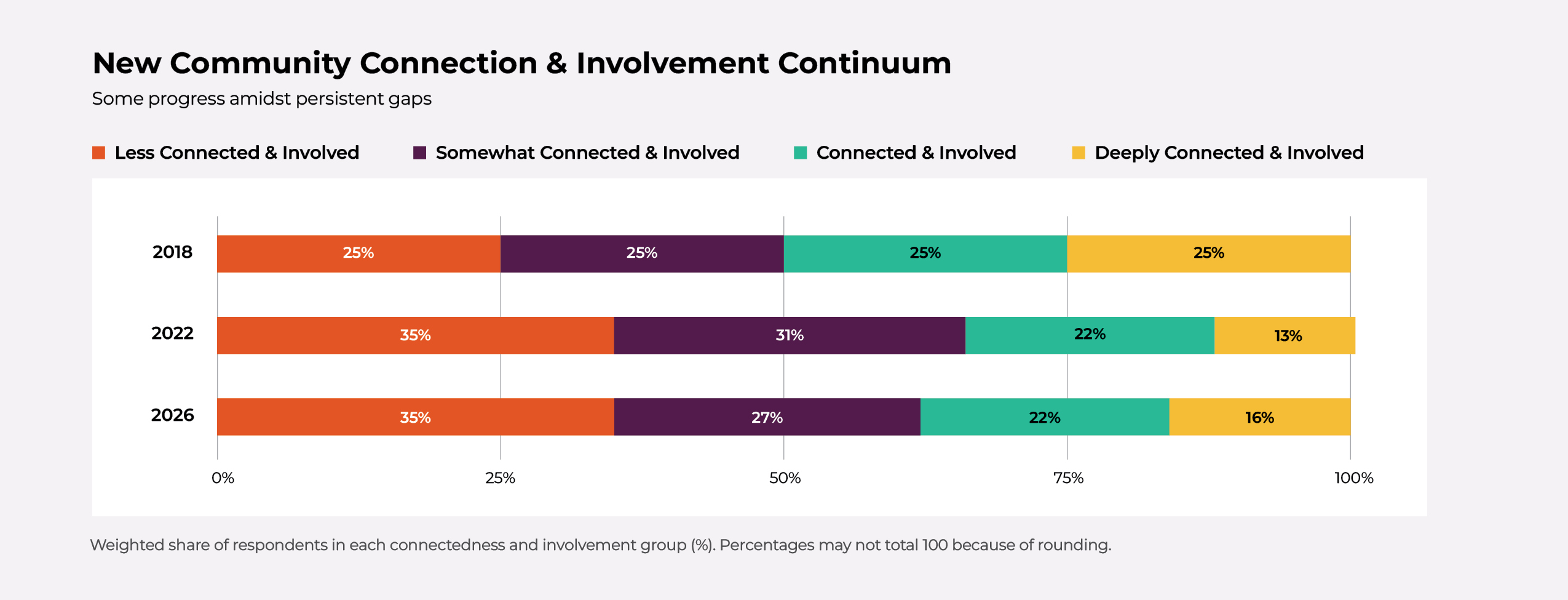
More Torontonians are Deeply Connected & Involved than in 2022, but the share of those least connected remains at about the same level. Between 2022 and 2026, the share of Torontonians who were Deeply Connected & Involved grew from 13% to 16%. The improvement appears to be driven primarily by renewed civic engagement, including a rebound in volunteering to 33%, just shy of its 2018 level of 37%, as well as increased interest in politics, rather than a broader recovery in social networks.
How to read the continuum
The Community Connection & Involvement Continuum brings together measures of Torontonians’ social networks and civic engagement, using the same questions in each survey since 2018. Rather than looking at friendship, participation, volunteering or political involvement one measure at a time, it shows how these different forms of connection and involvement come together across the population.
The four groups were created by dividing the 2018 results into approximately equal quarters. Those thresholds were then held constant in 2022 and 2026, allowing us to see how the distribution has shifted over time.
The Continuum does not capture every form of connection or contribution. Informal helping, mutual aid and grassroots activity are among the things it can miss.
Conversely, the share of Torontonians who are less connected and involved remains at 35%—exactly where it was in 2022.
Just under 1 million (970,000) Torontonian adults are now in the Less Connected & Involved group, about 270,000 more than if Toronto still had its 2018 distribution.
That leaves Toronto with a very different distribution than eight years ago. The Deeply Connected & Involved group, at 16%, remains well below its 2018 baseline of 25%, while the Less Connected & Involved group, at 35%, remains well above its baseline of 25%.
So, what helps people become more connected and involved?
The differences between Torontonians across the Continuum offer some important clues.

Connection and involvement are not equally distributed
Who reaches the deeply connected and involved end of the Continuum differs sharply by income and education.
In 2026, 21% of university-educated Torontonians were Deeply Connected & Involved, compared with 11% of those with high school or less. Similarly, 22% of people in households earning $100,000 or more reached the deeply connected and involved end, compared with 8% of those earning less than $30,000.
These are among the largest demographic gaps in the data. Education or income alone do not determine where someone falls on the Continuum. But they are a reminder that the pathways into community life do not begin from the same starting point. Time, money, access and opportunity can all shape people’s ability to participate.
And there may be another dynamic at work: connection itself can create more opportunities to connect.
What surprised us
Connection begets connection? The unexpected social pattern around AI
For the first time in 2026, we asked Torontonians how they are using AI in their personal lives for advice and companionship. Already, these uses are common: 46% had used AI for personal advice, 24% for companionship, and 15% for romantic or sexual conversation, often or occasionally in the past year. Nearly one in five (18%) reported often turning to AI for personal advice.
But, contrary to what we might assume, the pattern is not one of socially isolated people turning to a machine in place of human connection. Across the measures we looked at, people using AI for advice and companionship were often already among Toronto’s more socially connected and involved residents. Torontonians satisfied with how often they communicated with friends and family were about twice as likely to use AI for companionship, 26% compared with 12% among those who were dissatisfied. And 53% of people belonging to at least one group used AI for personal advice, compared with 37% of those belonging to no groups. Similar patterns appeared across belonging, contact with friends and use of community spaces, with little evidence that AI use was concentrated among those who were most disconnected.
Age and immigration history are part of the picture. Among Torontonians aged 18–24, 75% had used AI for personal advice and 46% used it for companionship. Use was similarly high among immigrants who had lived in Canada for less than 10 years, at 72% and 46%, respectively, compared with 46% and 24% across Toronto overall. These groups overlap, so we can’t tell how much each factor independently contributes.
For now, AI use for advice and companionship appears to exist alongside strong human connection rather than in its absence. The longer-term question is whether AI continues to complement human relationships or increasingly begins to take on the roles those relationships now play.
From showing up to getting involved
Education and income are strongly associated with being more connected and involved, but they do not tell the whole story. Deeper connection and involvement are also associated with something more tangible: having ways into community life—and reasons to keep showing up.
Places to go
Among Torontonians who regularly used three or more types of community facilities, including parks, libraries, recreation facilities and community centres, 45% were Deeply Connected & Involved. Among those who strongly agreed there were places nearby where they could meet and get to know others, 36% were Deeply Connected & Involved, compared with 15% among those who strongly disagreed.
As we saw in chapter 3, places can create the conditions for connection. In a randomized trial involving more than 500 neglected vacant lots in Philadelphia, greening those spaces increased nearby residents’ use of outdoor spaces for hanging out, relaxing or socializing by 76%, while reducing avoidance of going outside because of safety concerns by 58%(Branas et al., 2018).

Reasons to return
About 31% of Torontonians attending religious services weekly were Deeply Connected & Involved, compared with 10% of those who never attend. Whatever role faith itself plays, religious communities also provide something increasingly uncommon: a place to return to and people to encounter regularly.
That repetition can help turn participation into relationships. In a randomized trial with lonely older adults, 45% of those offered facilitated small-group activities made a new friend, compared with 32% in the control group (Routasalo et al., 2009). A pilot trial with women in Lebanon found that seven weekly sessions of training and structured dialogue at a community centre improved belonging and civic engagement (Sieverding et al., 2026).

Opportunities to contribute
Looking specifically at social connectedness, 33% of people belonging to at least one group were among Toronto’s most socially connected residents, compared with 14% of non-members. Volunteers were almost twice as likely to be among the most socially connected: 37%, compared with 19%.
Contribution can strengthen the contributor too. In a randomized trial, older adults who volunteered regularly to support other lonely older adults experienced medium to large reductions in loneliness after six months, along with greater engagement within their own social networks (Warner et al., 2024).
Toronto’s data cannot tell us whether any one of these pathways can overcome the large differences associated with income or education, or which investments would produce the greatest gains first. But, across very different interventions, the experimental evidence is consistent with what we see here.
Connection and involvement appear easier to build when people have places to participate in community life, reasons to keep showing up and meaningful opportunities to contribute.
What's New
Local Media: Finding the pathways to community
Places, groups and opportunities can only become pathways into community life if people know they exist. Local media can provide that visibility and is part of the infrastructure that supports community life. Nearly nine in ten Torontonians use at least one source each week to get news about their community, with social media and television the most common. Most residents also cross the traditional-digital divide: 55% use both a traditional news source and an online-only source in a typical week.
People who consume more community news also tend to be more trusting across differences, including of people whose backgrounds, languages or political views differ from their own. The survey cannot tell us whether community news builds that trust, whether more trusting people seek out more news, or whether both reflect a broader orientation toward community. But the relationship appears across several measures.
More strikingly, engagement with community news goes hand in hand with participation in community life. In 2026, 30% of Torontonians who read a community newspaper at least weekly were Deeply Connected & Involved, compared with 11% of those who never read one. Among those using three or more sources of community news each week, 40% participated in two or more groups, compared with 22% of those using fewer than three sources. Similarly, 40% of those using three or more community-news sources volunteered, compared with 28% of those using fewer sources.
OPPORTUNITIES FOR ACTION
From Connection to Cooperation
There is an appetite to participate. There are significant disparities in who does. And the evidence points to three essential ingredients of stronger community life: places to gather, reasons to return and meaningful opportunities to contribute.
What if we invested in these pathways as essential infrastructure for our city, giving more Torontonians the chance to build relationships, find belonging and work together to shape our future?