Home > Vital Signs 2026 >
From Places to Participation
Participation is down, but the appetite to join and gather remains.
Toronto has long been a city of joiners. That makes what has happened to its group life especially striking.
Torontonians now participate in nearly 40% fewer groups than they did eight years ago. The average fell from 1.44 groups per person in 2018 to about 1.0 in 2022, and then to 0.88 in 2026, across the same set of groups. The steepest drop came between 2018 and 2022, but participation has continued to slip.
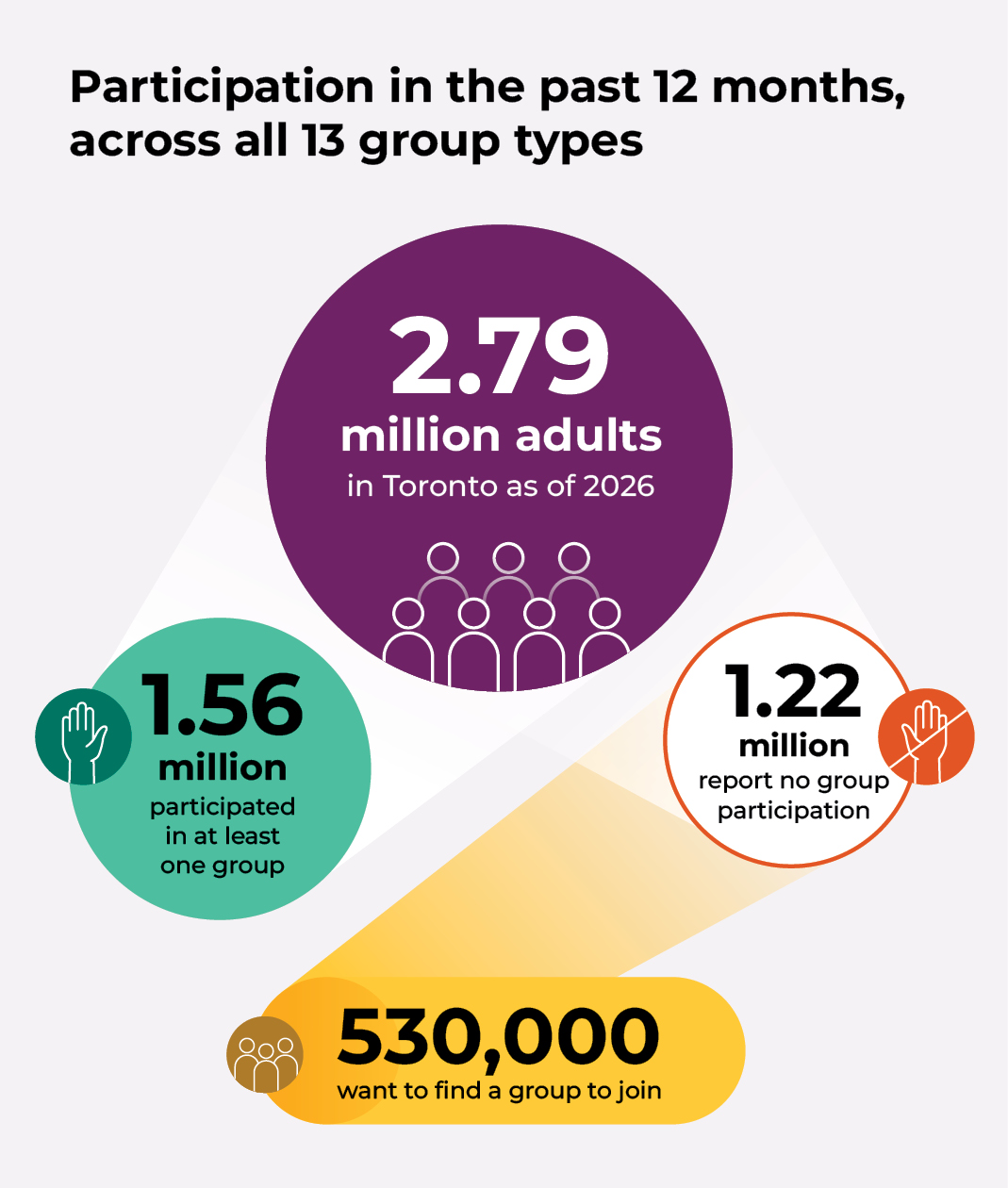
Yet, the decline is not the whole story. More than half a million Torontonians who currently participate in no groups say they would like to join one and many of the places where connection happens remain well used.
That is the participation paradox: Torontonians are still showing up and many want to join, but fewer are making the leap into group participation. To understand why, we first need to look more closely at who is and isn’t participating.

Fewer Torontonians are participating in groups
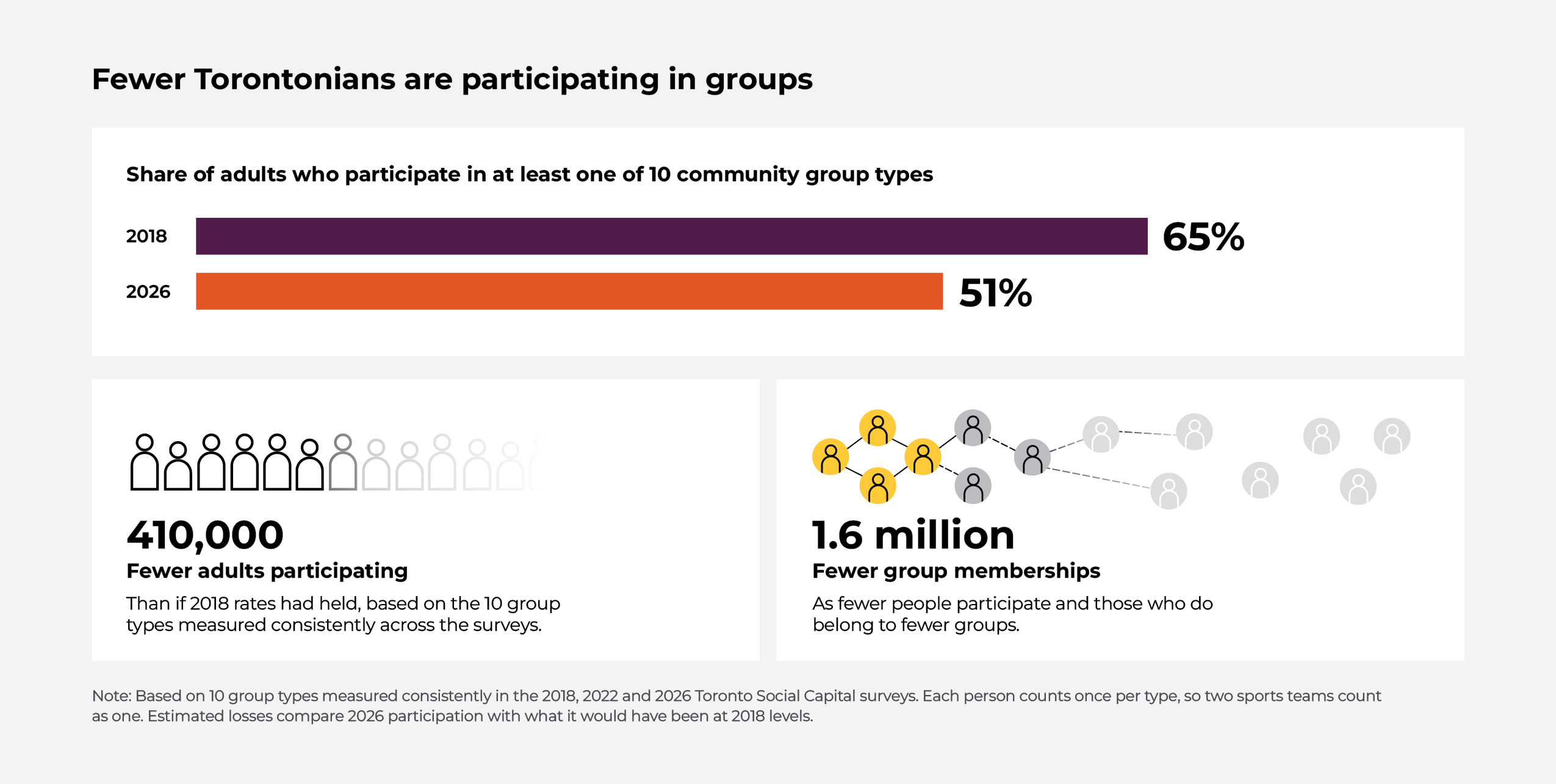
The scale of the decline is substantial. Participation in at least one community group fell from 65% in 2018 to 51% in 2026—equivalent to roughly 410,000 fewer adults participating than if 2018 rates had held, based on the 10 group types measured consistently across the surveys. And because those who still participate belong to fewer groups, the cumulative loss is larger still: almost 1.6 million fewer group memberships.
Groups matter—not simply as places to spend time, but as institutions of social cooperation. By bringing people together repeatedly around shared goals, they can build trust, reciprocity and habits of cooperation that help communities act together (Putnam, Leonardi, and Nanetti, 1993). Their benefits can also be personal: longitudinal research has linked joining groups to a lower risk of depression relapse, while a randomized trial found that strengthening group-based belonging reduced loneliness and depression (Cruwys et al., 2013; Cruwys et al., 2022).
Participation is down across almost every kind of group
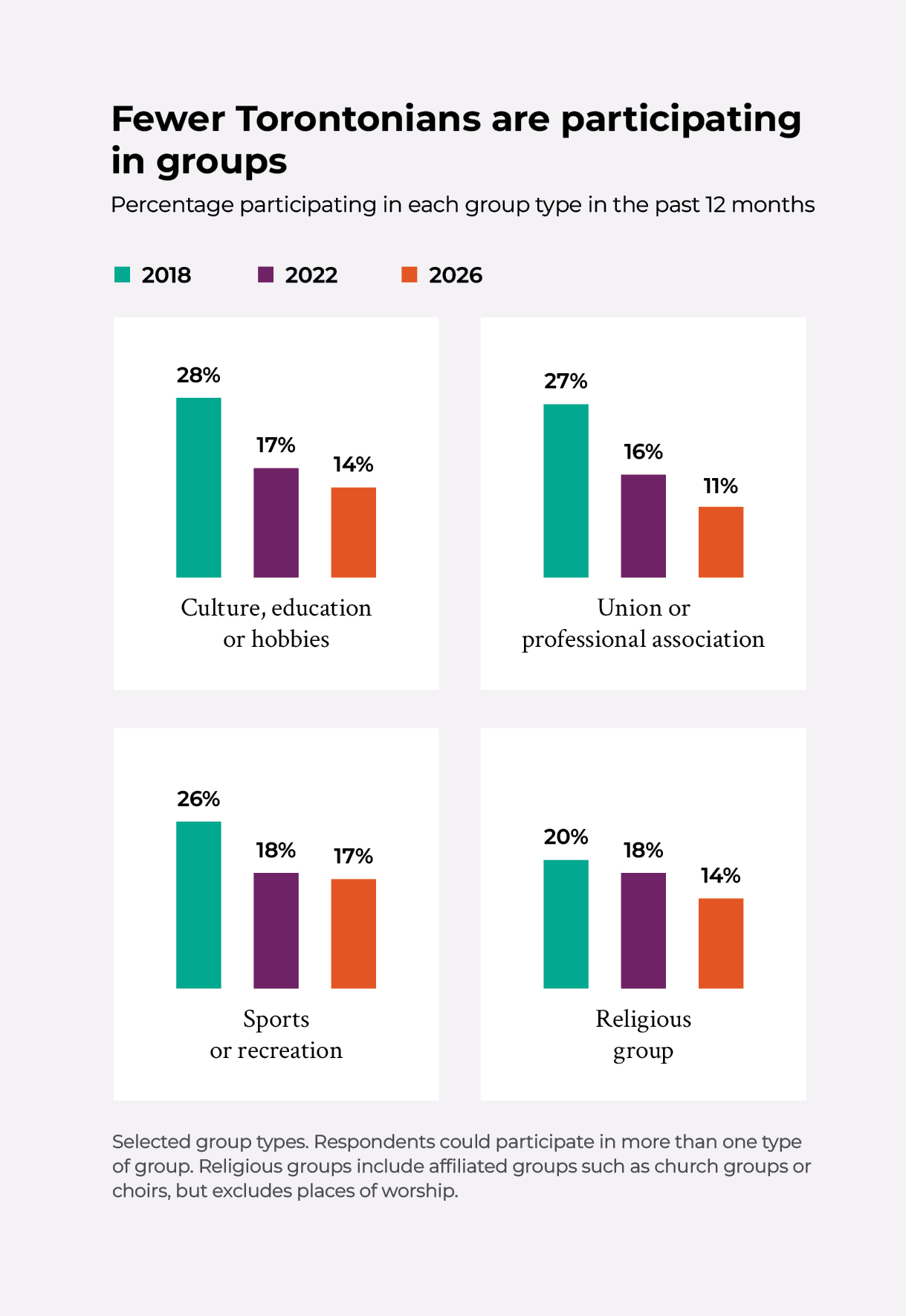
Participation declined across nine of the 10 group types that can be compared consistently between 2018 and 2026. Cultural, educational and hobby group participation roughly halved, from 28% to 14%, while union and professional association participation fell from 27% to 11%. Participation in sports and recreation organizations fell from 26% to 17%, and that for religious-affiliated groups from 20% to 14%. Unlike all other groups, participation in sports and recreation hasn't changed much between 2022 and 2026.
In 2026, 14% of Torontonians participated in a neighbourhood group or association, making these the third most common type of group participation. Measured for the first time in 2026, this highlights the importance of local organizations as places where Torontonians connect and act together.
Who participates is changing
The decline also crosses almost every part of the population. Across age, education, income, gender, immigration generation and racial identity, participation among every group was down between 2018 and 2026. But there are some notable differences.
Older adults once stood out for their greater involvement in groups, but that advantage has largely disappeared. Between 2018 and 2026, the average number of group types participated in by adults aged 60 and older fell by roughly half, from 1.8 to 0.9. Most of this decline occurred by 2022.
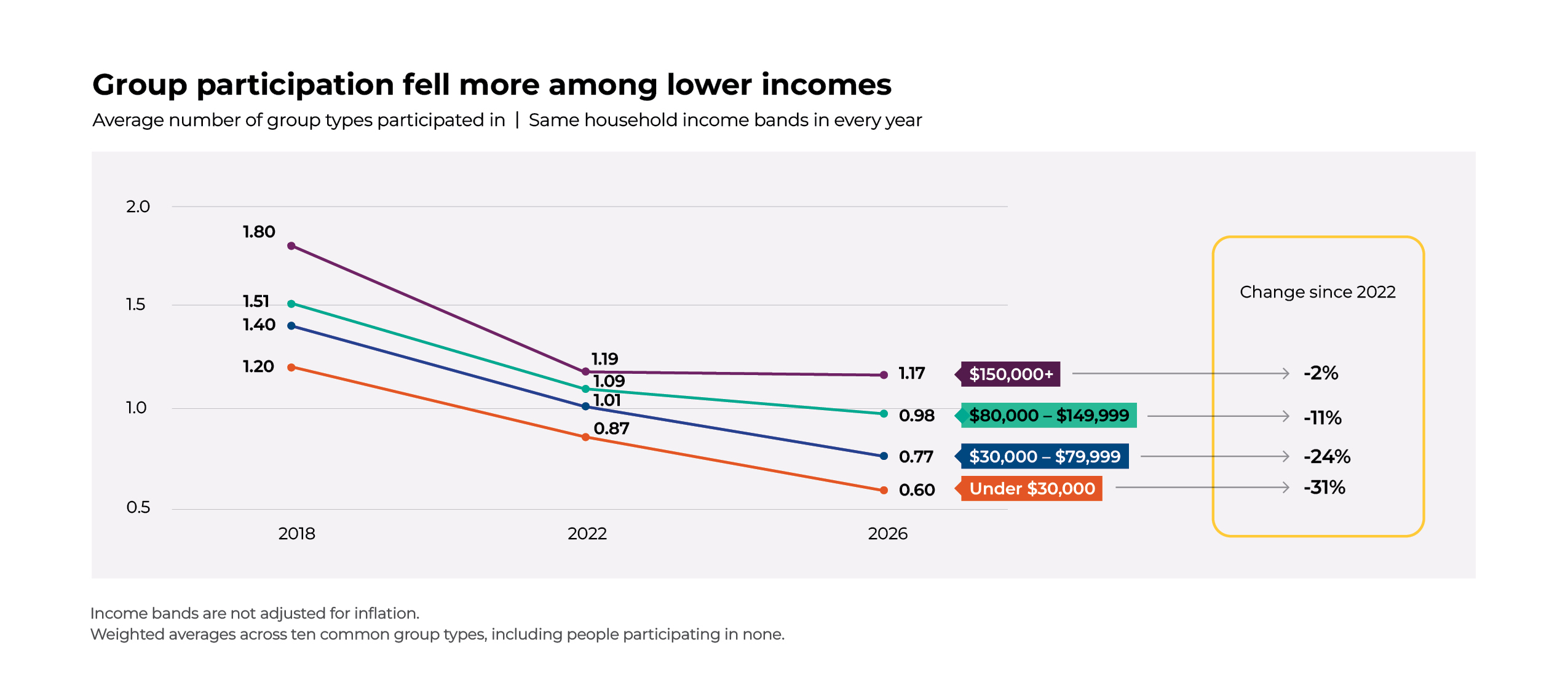
Income tells a different story. From 2018 to 2022, group participation fell sharply across every income level. Over the next four years, those paths diverged. Participation essentially held steady among Torontonians with household incomes of $150,000 or more, declining by just 2%, compared with declines of 11% among those earning $80,000–$149,999, 24% among those earning $30,000–$79,999, and 31% among those earning under $30,000. Note that is not adjusted for inflation.
The result is a significant gap in who participates today. In 2026, 67% of Torontonians with household incomes of $150,000 or more participated in at least one group, compared with 45% of those with household incomes below $30,000. These figures cover all 13 group types measured that year. Higher-income Torontonians also participated in nearly twice as many types of groups, on average.
Education reveals another divide. Across the same 13 group types, 65% of university-educated Torontonians took part in at least one group, compared with 47% of those with a high school education or less. These gaps are visible across the city too, with some of the lowest participation in neighbourhoods facing greater economic pressures, as we explore later in this chapter.
What began as a broad decline in group life is increasingly becoming an income divide in who gets to participate.
Torontonians still want to join
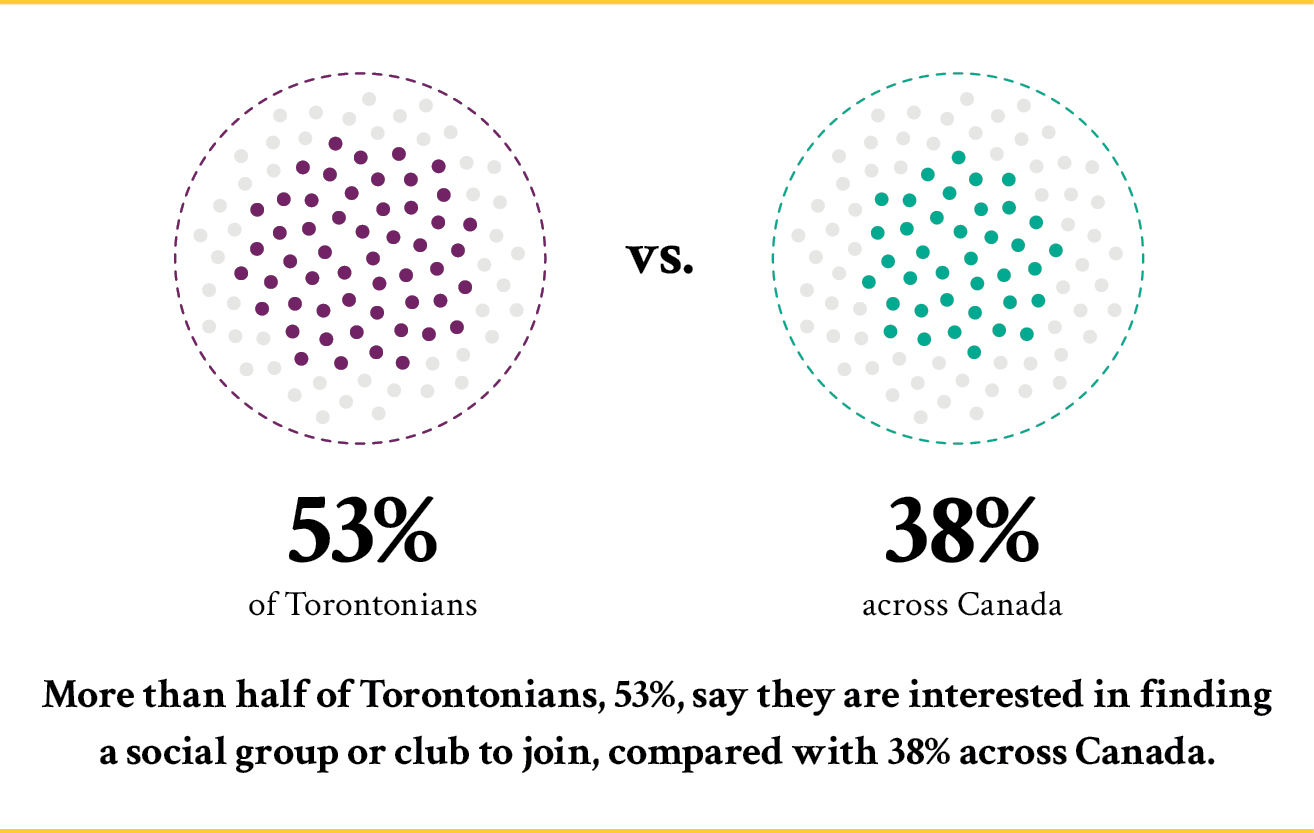
Despite the overall decline, the appetite to participate remains exceptionally strong. More than half of Torontonians, 53%, say they are interested in finding a social group or club to join, compared with 38% across Canada. Toronto also continues to outpace the national rate in participation in seven of the 10 types of groups measured nationally.
Even among people participating in no groups at all, 43% want to join one. That represents an estimated 530,000 Torontonians who currently participate in no groups, but would like to find one to join.
Noted earlier, 410,000 more adults would be participating today if the 2018 participation rate had held. The number of people outside group life who want to join is larger than that shortfall. The 530,000 figure covers all 13 group types measured in 2026, while the shortfall is based on the 10 types tracked since 2018.
Resourcing Participation: An Equity Imperative
Many of the nonprofits that create opportunities to participate are under pressure.
In 2026, nearly 80% of Toronto nonprofits reported increased demand, yet only 13% said they could fully meet it. About two-thirds (64%) could only somewhat meet demand, while another 21% could not meet it at all (Ontario Nonprofit Network, 2026).
These pressures do not explain the decline in Torontonians’ group participation on their own. Cost, time, awareness and changing work or family patterns may also make joining harder.
But capacity matters for equity. Ensuring that community organizations have the capacity to create affordable, accessible opportunities to participate may be particularly important for closing participation gaps.
Perhaps the most striking contrast is between who participates and who wants to.
The large gaps in participation by income and education are not mirrored in interest. Across income and education groups, between 49% and 58% were interested in finding a social group or club in their community. The desire to participate is much more evenly distributed than participation itself.
Interest in joining is geographically widespread, including in areas where participation is lower. In Jane–Finch–Black Creek–Richview and Scarborough Centre, roughly six in ten residents are interested in finding a group to join—above the citywide average of 53%. Yet, only about half currently participate, below the Toronto average of 56%. The appetite for group life extends beyond the parts of the city where it is already strongest.
Those interested in joining span income and education levels, but some groups stand out: nearly half are under 40, just over half rent their homes and two-thirds were born outside Canada. Most already feel a strong sense of belonging to their community.
The paradox does not reflect a lack of interest. Torontonians want to participate, but that appetite is not translating into participation.
From Places to Participation
The participation paradox becomes even more apparent when we look at Toronto’s community spaces.
In 2026, 60% of Torontonians agree there are places near them where they can meet and get to know others in their neighbourhood, although only 14% strongly agree. Torontonians are also more likely than Canadians overall to live close to several kinds of community spaces.
People appear to be using these spaces a bit more. Between 2022 and 2026, regular or occasional use of the community facilities measured increased by about three percentage points on average. (There is no comparable pre-pandemic data, so we cannot say how much of this represents a recovery.)
What stands out is the divergence: use of community spaces is rising, while group participation continues to decline.
OPPORTUNITIES FOR ACTION

A City of Joiners
More than half a million Torontonians want to join a group but haven't yet found their way in. And that desire is just as strong among people with lower incomes, even though their participation is much lower.
What if we made it easier for people to turn their interest into participation?
We can turn that possibility into reality by helping people discover opportunities close to home, making joining more welcoming and affordable, and investing in community organizations that bring more people together.