Home > Vital Signs 2026 >
More than the size of our social networks
Social networks have shrunk across our three surveys and each rung matters.
Torontonians are close to fewer people than they were eight years ago.
Between 2018 and 2022, social networks contracted sharply. Four years later, much of that loss has endured.
Our closest circles shrank sharply by 2022 and have not grown back. Our wider circles of friends and acquaintances have continued to shrink, and fewer of us say we can always count on someone for help.
Toronto's social worlds may be smaller, but who feels the loss—and how deeply—is more complicated.

Our closest relationships are smaller and less dependable
The decline of close relationships extends across friendship and family networks.
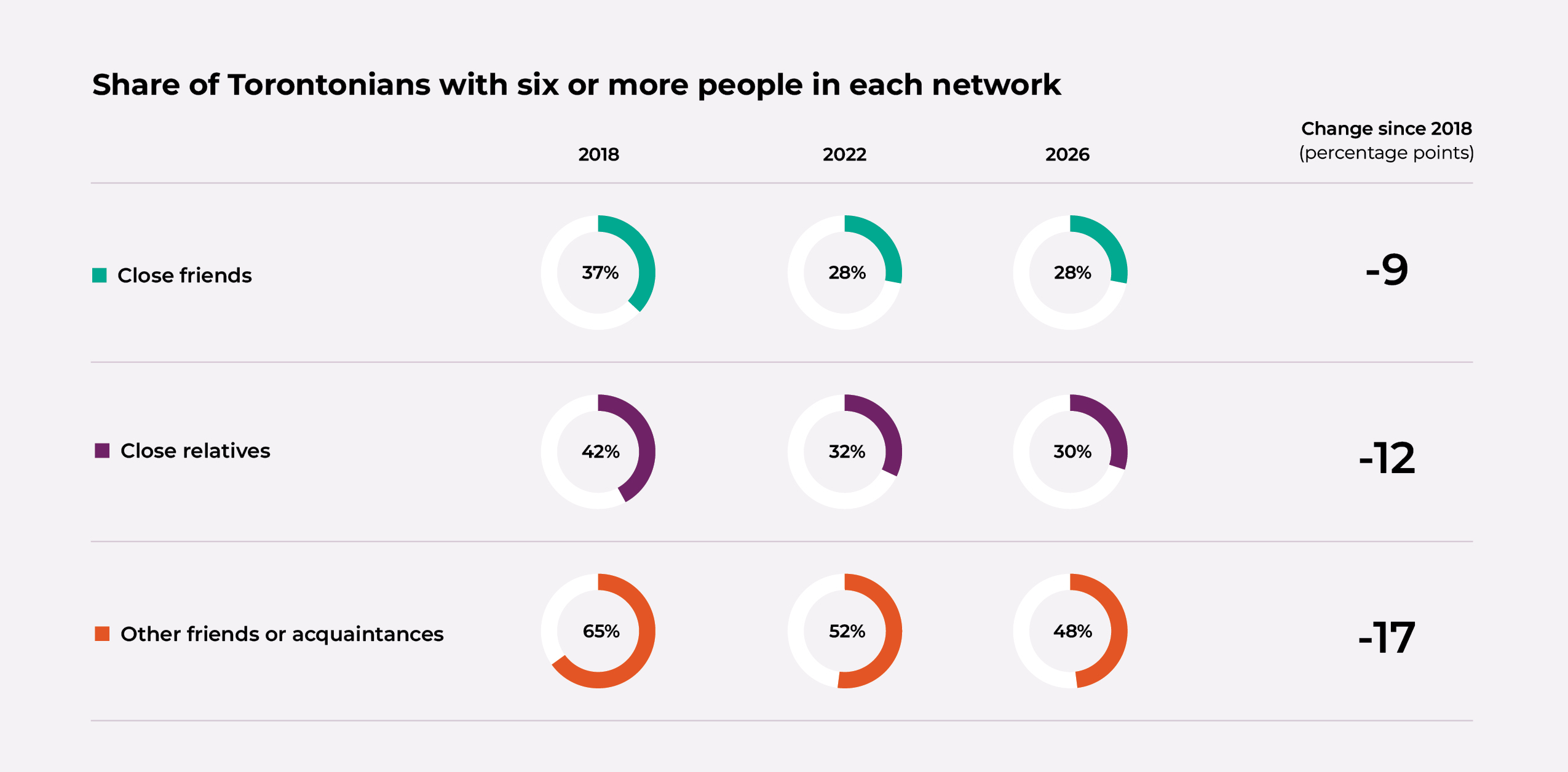
In 2018, 37% of Torontonians —nearly four in ten people—reported having six or more close friends. By 2026, that had fallen to fewer than three in ten, at 28%. Close family networks shrank even more: the share with six or more close relatives fell from 42% to 30%.
Most of these losses happened during the pandemic. Since 2022, close friendship and family networks have largely stopped shrinking—but they haven't grown back.
And it’s not only the size of our circles that has changed. In 2026, about 840,000 Torontonians (30%) said they always had someone they could depend on when they needed help, down from 43% in 2018. At today’s population, that 13-point decline represents roughly 360,000 fewer Torontonians with someone they can always depend on. Fewer people are also highly satisfied with how often they communicate with friends, down from 29% to 22%.
There has also been a smaller shift among Torontonians with the fewest close relationships. The share of Torontonians with only a few close friends or family members has increased modestly, from 8% in 2018 to 12% in 2026.
These changes matter for wellbeing. Torontonians with smaller close networks are much more likely to report fair or poor mental health. Longitudinal research points in the same direction: smaller networks predict later depression in most studies examining the relationship, while stronger social support predicts better subsequent mental health even more consistently (Wickramaratne et al., 2022).
Loneliness may be easing, but not for young Torontonians
Three years ago, Toronto’s Vital Signs described Toronto as the loneliest city in Canada. The latest evidence does not point to worsening loneliness. But the picture looks starkly different by age.
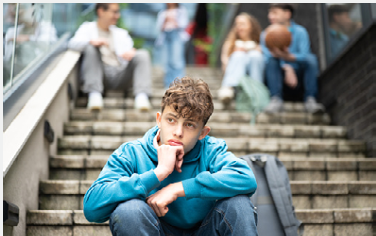
In 2026, 23% of Toronto adults said they felt lonely on at least three days in the past week. That share was 40% among 18- to 29-year-olds. Among adults 30 and older, it was 19%, compared with 31% in a separate survey reported in Toronto’s 2023 Vital Signs Report.
Comparisons with those earlier results should be treated with caution because they come from a different survey than the rest of the 2022 data.
Toronto’s wider social circles have shrunk sharply
Toronto’s social contraction extends beyond our closest relationships. In 2018, 65%—nearly two-thirds—of Torontonians had six or more other friends or acquaintances. By 2026, that had fallen to 48%—about one in two. Unlike close friendship and family networks, wider circles continued to shrink after 2022.
Wider networks may also matter for our ability to act together. In Toronto, 58% of those with more than 20 friends or acquaintances in addition to their close friend circle believe people working together can make a big difference, compared with 38% of those with five or fewer—a 20-point gap.
These relationships serve different purposes from those of our closest friendships and family ties. Neighbours we stop to chat with, colleagues we trust, fellow volunteers, people we know through community groups and familiar faces we encounter from week to week connect us to people, information, opportunities and parts of the city beyond our immediate circles.
Research suggests these wider ties can lead to meaningful opportunities: large randomized experiments on LinkedIn found that connections with acquaintances—people outside our closest circles—could help people move into new jobs, while U.S. research links friendships across income groups with greater upward economic mobility (Rajkumar et al., 2022; Chetty et al., 2022).
Financial strain, age and gender reveal different losses in connection
The sharpest losses since 2018 are concentrated among Torontonians under the greatest financial strain. Among those who say their income is not enough and they are having a hard time, the share with only few or some close friends or family rose from 58% in 2018 to 72% in 2026. Over the same period, the share who say they always or often have people they can depend on fell from 42% to 33%.
Older Torontonians have also experienced substantial erosion in their social connections since 2018. Among adults 60 and older, the share with only few or some close friends or family rose from 35% in 2018 to 52% in 2026, while the share that are very satisfied with how often they communicate with friends and family fell from 39% to 24%.
Women started from a stronger position than men on several measures in 2018, but that advantage has narrowed by 2026. Among women, frequent in-person contact with close friends and family fell from 33% in 2018 to 25% in 2026, while remaining essentially unchanged among men, at 27% and 28%, respectively. Over the same period, the share of women who always or often have someone they can depend on fell from 75% to 60%.
Our Social Network Index combines measures of close relationships, wider networks and social support. Differences between women and men in 2026 are not statistically significant.
OPPORTUNITIES FOR ACTION
Widening Our Circles
Our wider social networks connect us to new people, different perspectives and opportunities beyond our immediate circles. Yet these are precisely the relationships that have continued to shrink.
What if we created more opportunities for Torontonians to get to know people beyond their existing circles?
By supporting more neighbourhood gatherings and shared activities, we can help people from different backgrounds build relationships and find common purpose.