When it comes to social health, Toronto is among the most deeply researched cities in the world. More than 10,000 Torontonians have taken part in our research over a formative eight years, with new groups of over 3,000 surveyed in 2018, 2022 and 2026. Together, those three snapshots reveal a complicated picture: real losses in how we connect and participate, alongside signs of endurance and possibility.
Our first two studies focused primarily on social capital: the relationships, trust, belonging and participation that connect us to one another and our communities. In 2026, we’ve widened the lens to ask what those connections add up to across a city and what they make possible: our capacity to cooperate and tackle shared challenges together.

What has weakened
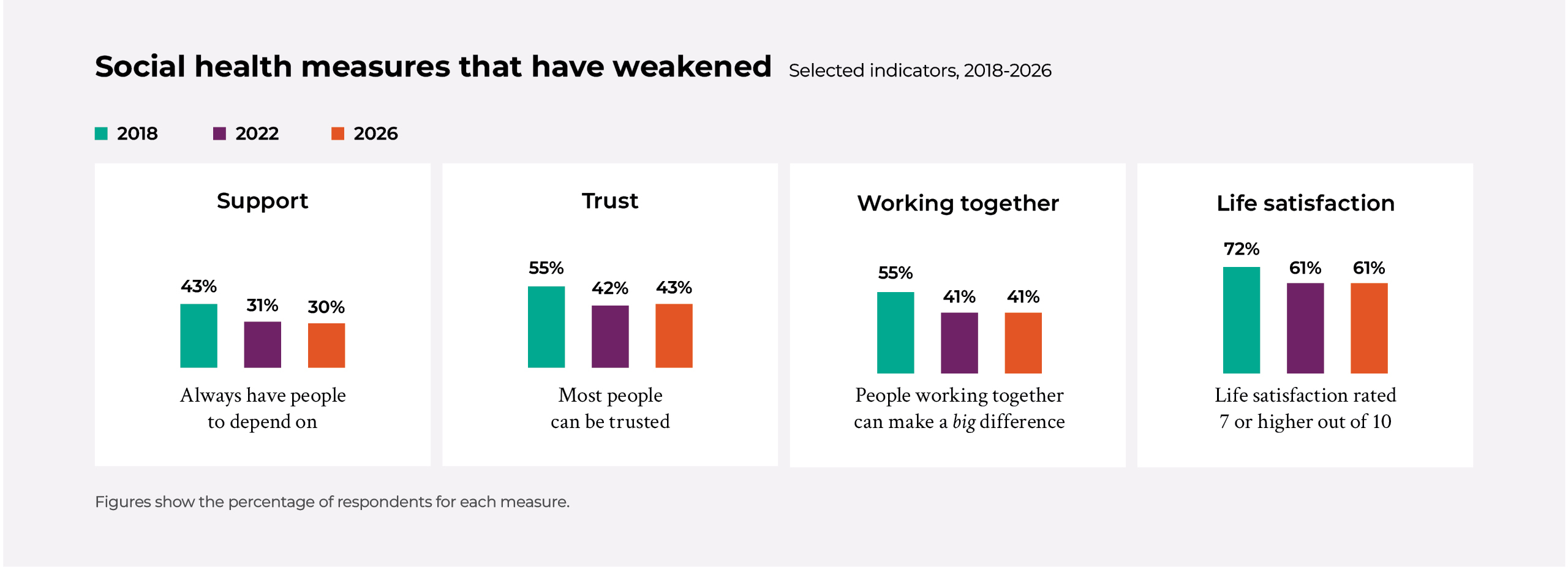
The eight-year picture reveals some significant and persistent weaknesses. Social networks are much smaller than they were in 2018. Participation in community life is lower. Trust in people generally and confidence in what people can accomplish together have declined. Wellbeing and life satisfaction also remain substantially lower.
Some of those shifts are stark. The share of Torontonians with six or more close friends has fallen from 37% to 28%. The share that believes people working together can make a major difference has fallen from 55% to 41%.
Across eight years of data, household income stands out as one of the clearest dividing lines in wellbeing and connectedness. Those differences have unfolded through a period of growing economic pressure, with rising housing and living costs putting increasing strain on many household budgets, alongside the widespread disruption of the pandemic between 2018 and 2022.
Since 2022, however, the trajectories of different income groups have diverged: Torontonians with the highest household incomes have seen more improvement, while those with the lowest incomes have often seen little improvement or further losses. Volunteering, for example, has rebounded much more strongly among the highest-income group. The surveys suggest widening gaps across several dimensions of wellbeing and connectedness, including participation, life satisfaction, mental health and trust in other people.
In 2026, one in three Torontonians experiences food, housing or income insecurity.* These pressures are part of the story of social connection and participation, shaping the opportunities people have to get involved in community life.
*Based on this study’s definitions, which capture some—but not all—forms of financial hardship. See the Economic Insecurity companion analysis for details.
What has endured
Toronto’s social health has not weakened across the board.
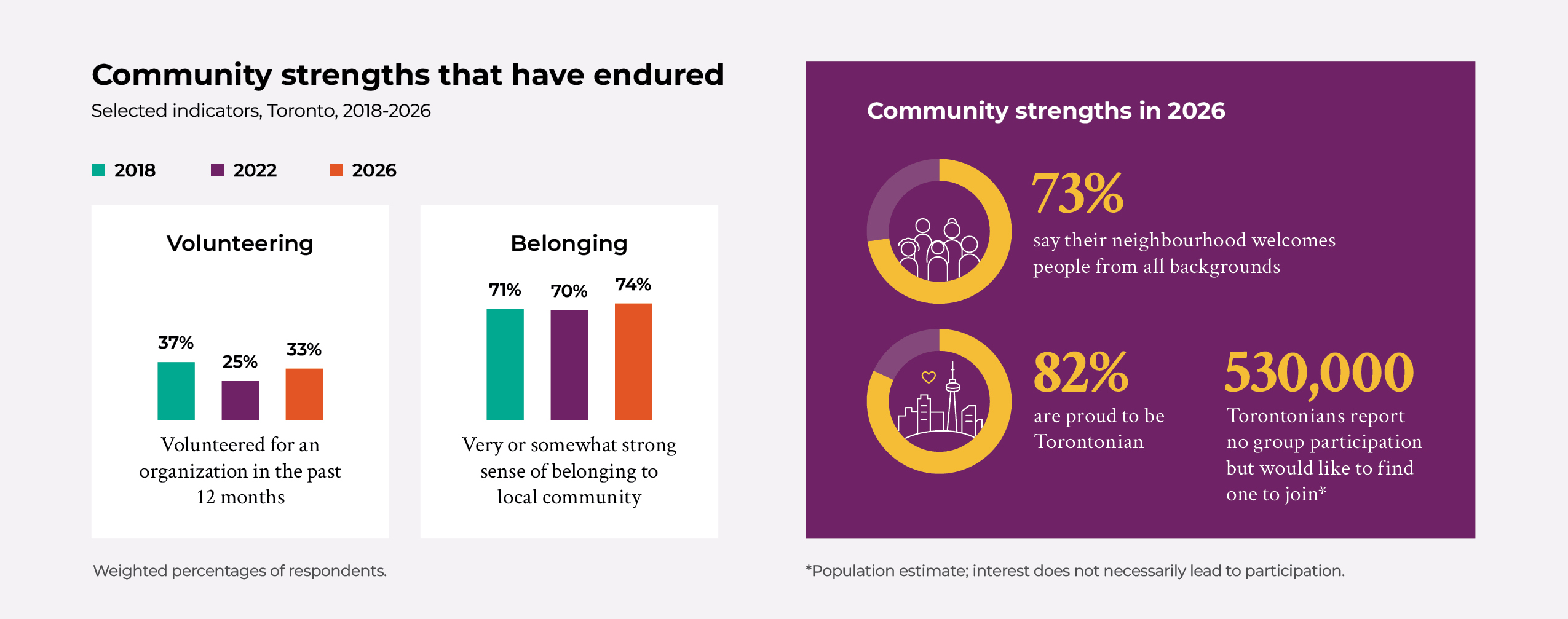
Some foundations of community life have proved more durable. Most Torontonians continue to see their neighbourhoods as welcoming and their neighbours as willing to help. Even as trust in people generally has declined, trust in people with different political views or ethnic backgrounds, and in strangers, has remained broadly stable. Confidence in most local institutions has also changed relatively little, and more than four in five Torontonians (82%) are proud to be Torontonian. And, while fewer believe people working together can make a major difference (41%), there is still widespread belief that working together can make at least some difference (85%).

Signs of possibility
There are also promising upward swings. In 2026, 74% of residents reported a strong sense of belonging to their local community, up from 70% in 2022. The rate of volunteering, which fell to about 25% in 2022, has climbed back to 33%, just short of the 37% from 2018. Frequent use of local facilities such as community centres, libraries and recreational facilities has also increased since 2022 across most types of spaces we measured.
And the appetite to participate remains. An estimated 530,000 Torontonians, who currently belong to no groups, say they would like to find one to join. That doesn’t tell us whether they will join, but it does suggest that declining participation is not the same as declining interest in community life.
Eight years of data therefore tell a more complicated story than that of simple decline. Some of the ways Torontonians connect, participate and experience community have weakened considerably. But the belief that community matters—and that people can make a difference together—remains.
OPPORTUNITIES FOR ACTION
A City That Believes in Community
What if we turned Torontonians' belief in community and desire to participate into one of our city's greatest strengths?
The chapters that follow look more closely at the gap between belief and experience: where our social worlds have contracted, what gets in the way of participation and what distinguishes Torontonians who are connected and involved from those who aren’t. Together, the findings offer clues about how we might turn that belief in community into stronger relationships, more participation and a greater capacity to build a better city together.